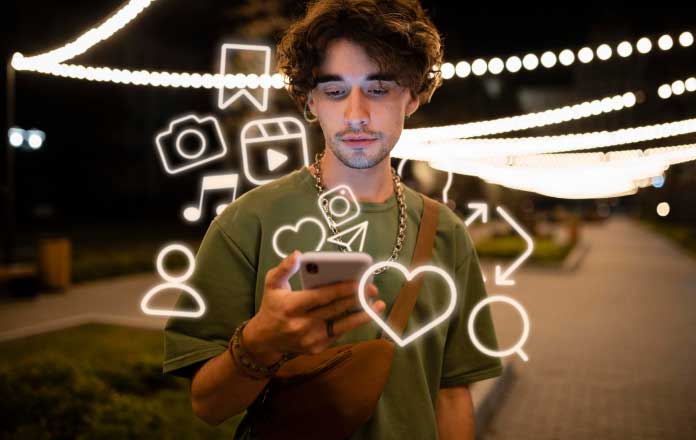

In the digital era of today, influencer marketing is one of the most effective methods through which brands are able to reach their audience. Just selecting influencers with a lot of followers no longer promises success. That’s where artificial intelligence (AI) enters the picture, AI algorithm-powered tool that is revolutionizing influencer-brand partnerships into more precise and data-based collaborations. Through the analysis of big data, pattern detection, forecasting and content customization. AI enables brands to participate in influencer partnerships that are not only effective but also highly consistent with the brand’s message and its fans interests.
How AI Is Redefining the Future of Influencer Marketing
Historically, brands seeking influencer partners evaluated profiles, counted followers, manually reviewed content, and trusted their gut on suitability. The process was slow, erratic, and frequently incorrect. With the boom of social media platforms and influencer behaviours, the number of potential prospects has multiplied manifold, and manual selection is no longer feasible.
Artificial intelligence revolutionizes everything. It does not only analyze surface metrics but also delves into the underlying interests, behaviours of influencers and their followers. Machine learning and advanced algorithm-powered tools enable brands to leverage lots of information regarding performance, audience information, and content patterns. Influencer marketing is increasing rapidly and may hit $3.5 billion by 2028.
A Data-Driven Approach to Influencer Selection
To describe how brands can leverage artificial intelligence for effective collaboration, let us take the example of the 5Ps framework: profiling, pattern detection, forecasting, personalization, and performance.
- Profile Analysis: Social Media Platforms and brands begin with collect comprehensive data on influencers and their audiences, including where they are from, how old they are, whether they are male or female, what kind of content they post, audience engagement, interests, and past history.
- Pattern recognition: AI systems analyze this data to identify patterns and relationships; for instance, it can recognize influencers who have audiences more engaged with green-related content or whose health posts drive more sales.
- Forecasting: Predictive analytics is applied in the subsequent step. The system predicts which successful partnerships are likely to yield optimum results, i.e., increased profits, improved sales, or increased brand expansion based on patterns and profiles.
- Personalization: After selecting influencers, brands are creating personalized campaigns on preference of the audience: tone, messaging, type of content, and posting time can be modified to make the campaign natural and contextual.
- Performance: The last step includes real-time observation and tuning. Artificial intelligence supports ongoing measurement and smart optimization: Did the audience of the influencer react as intended? If not, one can quickly adjust to perform better.
Through the use of this systematic method, brands move away from guesswork and towards data-driven and predictive decision-making. This enhances accuracy, lessens risks, and enhances the potential for successful campaigns.
Influencer Behavior Analysis
One of the biggest strengths of today’s AI is its ability to analyze and understand influencer behavior. Past follower or like numbers, AI looks at influencers values, content types, personality, and audience reactions. ANNs (Artificial Neural Network) can particularly effectively find concealed patterns, such as noticing that an influencer’s is not only interested in particular topics but also in particular emotional approaches or storytelling styles.
By knowing this dynamic, brands can collaborate with influencers whose values, ethos, and content style inherently resonate with the brand’s identity. The alignment ensures that the collaboration is not done artificially or out of place, which is an important aspect of attaining high engagement and genuine audience interaction.
Applying sentiment and behavior analysis to learn more deeply
Another significant benefit of AI here is that it can analyze sentiment and behavior on a mass scale. Through NLP and machine learning algorithms, platforms can cull great volumes of text (subtitles, comments, dialogues) to ascertain not just what’s being said, but the manner in which it’s being said (emotion, tone, intent). Research in the International Journal of Research in Marketing indicated that artificial neural networks attained between 85% accuracy when determining sentiment.
This implies that brands can analyze both negative and positive feedback from the influencer’s audience, whether the tone is congruent with the expectations of the brand and the receptiveness of the audience for the targeted message. For instance, a campaign for a sustainable skincare brand will be enhanced by an influencer that has a following which already engages highly in eco-friendly or wellness issues and has a favorable overall perception of these issues. The past content history of the influencer and what the audience reacts to become a significant consideration in making the decision, and not merely figures.
Why Brands Leaning Into AI
As artificial intelligence is increasingly woven into successful marketing platforms, its function will determine to a great extent which brands succeed in forging meaningful relationships with their audience. The 5Ps paradigm is a guide: begin with strong data profiling, recognize applicable patterns, forecast what will succeed, adjust messaging, and track results in real time. Brands that take this systematic approach are more likely to develop campaigns that resonate, engage deeply with the audience, and produce quantifiable outcomes, instead of using follower numbers or guesswork.
In the constantly changing digital world, attention is splintered, competition is cutthroat, and authenticity reigns. AI-driven influencer discovery provides brands with a competitive edge by allowing them to craft intelligent partnerships, uncover quicker insights, and run more precise campaigns. Rather than pursuing the influencer with the largest following or the greatest reach, brands are now able to discover the ideal influencer: one whose audience actually shares their values, message, and objectives.
Conclusion
The intersection of influencer marketing and AI is building a new path for brands to interact with influencer and their audience. With a process that incorporates profiling, pattern discovery, prediction of trends, personalization of content, and measurement of results, influencer collaborations are more precise and efficient. Employing sophisticated tools such as neural network analysis and NLP-based sentiment scoring, brands are able to turn their collaborations into compelling and relevant experiences, instead of single posts with indeterminate reach.
For brands who are willing to seize this opportunity, the word is out: In the age of AI-fueled influencer marketing, order matters as much as reach, relevance matters more than scale, and intelligence matters more than intuition. Welcome to the age of smart connections, where the appropriate creators align with the appropriate brands, and what ensues is a connection that gives us authenticity as well as commercial effectiveness.