




The rapid pace of technological change in the digital space has transformed the healthcare industry. Among these emerging technologies, the Internet of Things (IoT) has become a revolutionary force in transforming healthcare systems into more innovative, efficient, and patient-oriented systems. Ranging from wearables to smart hospital infrastructure, IoT is transforming medicine into an ambulatory service.
Understanding IoT in Healthcare
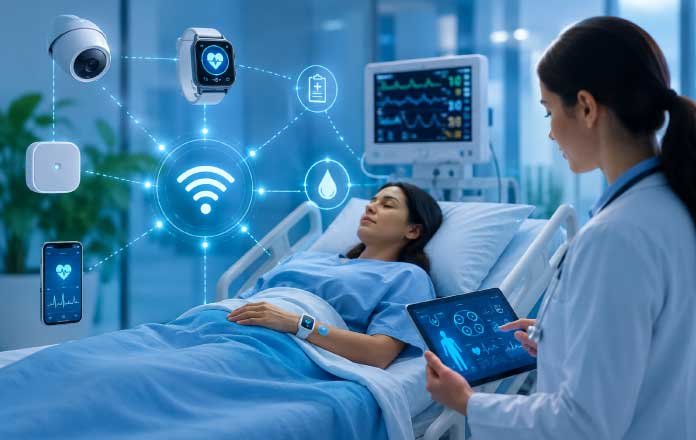
The IoT in healthcare, also known as the Internet of Medical Things, is a network of medical devices, sensors, apps, and systems that store and transmit healthcare information over the internet. Devices communicate with each other and healthcare professionals in real time, enabling healthcare providers to make decisions based on continuous online tracking data.
The IoT in healthcare combines physical healthcare devices with digital intelligence, enabling healthcare providers to remotely monitor patients’ health status, efficiently organize hospital operations, and improve healthcare quality. The main objective is to shift from a reactive healthcare model to a proactive, preventive model powered by IoT technology.
Essential Elements of IoT in Healthcare
Healthcare systems that are based on IoT have several interconnected components, such as:
Sensors & Devices: This category includes fitness trackers, heart rate monitors, glucose meters, smart inhalers, and implantable devices that measure physiological signals.
Connectivity: Devices’ data is transmitted wirelessly using Wi-Fi, Bluetooth, cellular networks, or cloud solutions.
Data Processing & Analytics: Complex algorithms are used in advanced software solutions to analyse massive amounts of health information, detect trends and generate alerts, and support medical decision-making.
User Interfaces: Dashboards, mobile apps, and portals enable patients and healthcare providers to interact with and make sense of information.



With these elements, a complete ecosystem is formed that enables continuous, personalised healthcare.
Use Cases of IoT in Healthcare
IoT finds application in a variety of domains in healthcare:
Remote Patient Monitoring: IoT devices enable continuous patient tracking for people with chronic conditions such as diabetes, cardiovascular disease, or asthma. Real-time information enables doctors to identify unusual occurrences and make necessary decisions without relying on constant hospital check-ins.
Wearable Health Devices: Smartwatches and fitness trackers can monitor vital signs, including heart rate, activity level, sleep habits, and blood oxygen levels. With these devices, people can manage their health personally and provide helpful information to medical practitioners.
Smart Hospitals: IoT is revolutionizing hospitals by improving asset management, tracking medical devices, managing environments, and enhancing workflow efficiency. For instance, IoT technology can help ensure the availability of essential devices.
Drug Administration: Intelligent pill dispensers and medication management systems not only remind patients to take their medication on time but also notify caregivers if patients miss any doses.
Emergency & Critical Care: IoT-enabled devices enable the rapid transfer of patient information during emergencies, aiding quicker responses and better decisions by medical staff and saving lives.
Benefits of IoT in Healthcare
The implementation of IoT in the healthcare industry has many advantages:
Better Patient Outcomes: Early diagnosis and treatment are facilitated by continuous patient monitoring.
Increased Patient Participation: Patients become active players in their healthcare with access to their own healthcare information in real time.
Cost Efficiency: The cost savings arise from reduced unnecessary hospitalization and reduced treatment costs.
Data-Driven Decision-Making: Reliable, up-to-date information enables better medical decisions.
Operating Efficiency: RPA technology ensures efficient working of hospitals, inventory, and other resources.
Challenges & Concerns
Although IoT in healthcare systems has many benefits, it also encounters some challenges:
Data Security & Privacy: Healthcare information is highly sensitive. The protection of healthcare information during transmission and storage is a serious matter of concern.
Interoperability Issues: Devices and platforms may lack standardization, making integration challenging.
High Implementation Costs: Small healthcare centers, in particular, face the challenge of investing heavily in IoT technology and training, as these costs are high.
Data Accuracy & Reliability: IoT’s performance is directly proportional to the accuracy of the data it gathers. Malfunctioning or incorrect sensors, or faulty network connections, can distort the situation.
Future Scope of IoT in Healthcare
Connected Wearables: The prospects of IoT in healthcare appear promising, driven by advancements in artificial intelligence, machine learning, and big data analytics. Predictive analytics will enable early disease identification and tailor-made treatment approaches. Implanted devices, wearables, and healthcare systems in a domestic setting will become common to support an ageing population and alleviate pressure on healthcare systems. Furthermore, IoT will be a vital factor in outcome-oriented healthcare, shifting its focus from quantity to quality.
The healthcare industry is witnessing a paradigm shift driven by IoT, moving from reactive to preventive care. IoT in healthcare is beneficial, enabling real-time monitoring and improving operational efficiency. The problems of cost, flexibility, and security continue to disrupt the industry, but the gap between technology and its adoption is narrowing as more innovations emerge. As healthcare continues its digital revolution, IoT will be a significant milestone in healthcare innovation.