






Artificial intelligence is no longer sitting on the sidelines of corporate strategy. CEOs across industries are experimenting with it, investing in it and looking for practical ways to bring it into everyday business.
But there is an interesting gap between adoption and impact.
An Arthur D. Little survey found that 96% of CEOs had already deployed artificial intelligence in some form. Yet only 13% said their organisation had a compelling, enterprise-wide strategy for the technology. In other words, most companies have started the journey, but relatively few appear to have figured out where they are actually going.
That distinction matters.
Moving Beyond Small Experiments
For many companies, the first step has been straightforward.
Customer service teams use intelligent tools to handle routine queries. Employees use them to search large volumes of information. Marketing teams use them to speed up content production, while analysts use them for research and decision support.
These applications can certainly save time.
The Arthur D. Little research found particularly strong applications across energy and utilities, manufacturing, healthcare, financial services and automotive. In these sectors, automation can take care of repetitive work and allow employees to spend more time on activities that require judgement and expertise.
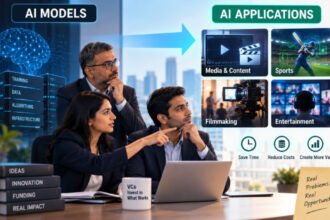


The problem starts when companies mistake automation for transformation.
Making an existing process faster does not necessarily make the business better. A company can automate a five-step process and still be stuck with a five-step process that nobody really needs.
That is where the CEO’s role becomes important.
The CEO Has to Ask a Bigger Question
Executives cannot treat artificial intelligence as another software project that can simply be handed over to the technology department.
The bigger question is: What should the business look like when intelligent systems become part of everyday work?
That question goes beyond productivity.
It touches customer experience, operating models, employee roles, decision-making and even the products a company chooses to build.
Some CEOs are already using these tools personally to challenge their own thinking. Rather than simply asking for an answer, they can use them to examine different scenarios, question assumptions and explore alternative viewpoints.
That can be particularly useful at the leadership level, where decisions often involve incomplete information and competing priorities.
But the technology remains a support system. The responsibility for the decision still sits with the executive.
Speed Matters, But Direction Matters More
One reason executives are moving quickly is simple: nobody wants to discover two years from now that competitors have built capabilities they ignored.
However, moving quickly does not mean buying every new tool that appears.
Companies need to identify the parts of the business where intelligent technology can create meaningful value. That could mean improving customer service, simplifying internal operations, strengthening forecasting or creating new products.
The focus should be on business outcomes rather than technology for its own sake.
This is also where many organisations face a practical problem. Different departments may start their own projects, use different systems and collect data in different ways. The result can be a collection of promising experiments rather than one coordinated strategy.
Employees Are Part of the Equation
Technology may receive most of the attention, but people remain central to the transition.
The Arthur D. Little survey found that 59% of CEOs saw a strong or very strong need to reskill employees, compared with just 13% in 2023. The change was even more dramatic in manufacturing, where the proportion increased from 5% to 68%.
This is an important signal for business leaders.
Introducing new technology without preparing employees is unlikely to deliver the expected results.
People need to understand how their jobs will change, which tasks can be automated and where human judgement will remain essential. They also need opportunities to develop new skills rather than being expected to figure everything out themselves.
For Indian businesses in particular, this could become an important competitive factor. Companies with large workforces cannot simply introduce new systems and expect adoption to happen automatically.
Training, communication and leadership involvement will matter just as much as the technology itself.
Efficiency Is Only the Starting Point
There is an obvious temptation for CEOs to focus on efficiency.
If a task that once took two hours can be completed in 20 minutes, the benefit is easy to understand. But the more interesting question is what the organisation does with those additional 100 minutes.
Does it simply produce more reports?
Or does it give employees more time to speak with customers, solve difficult problems, develop new ideas and make better decisions?
That is the difference between using technology to reduce effort and using it to change how the business operates.
The Risk of Protecting the Past
There is another issue CEOs need to consider.
Companies often use new technology to strengthen the business model they already have. That can be useful, but it can also create a blind spot.
If a company only asks, “How can this technology make our existing business more efficient?”, it may miss the more disruptive question: “Could this technology change the business completely?”
That is where leadership becomes more than implementation.
CEOs have to decide which old processes should disappear, which new capabilities deserve investment and where the organisation needs to take a calculated risk.
The Next Phase Will Be About Leadership
The widespread adoption of artificial intelligence suggests that the technology question is gradually becoming easier.
The leadership question is becoming harder.
Companies now have access to increasingly capable tools. The real differentiator will be how effectively leaders connect those tools with strategy, people and business priorities.
The numbers tell an interesting story. Almost every CEO may be experimenting with artificial intelligence, but experimentation alone does not create transformation. The organisations that gain lasting value will need a clear direction, employees who are prepared for change and leaders willing to rethink how work gets done.
For CEOs, therefore, the goal should not simply be to make yesterday’s business faster.
It should be to understand what tomorrow’s business could look like—and start building it today.