






Cloud computing is no longer just an IT upgrade for companies looking to reduce infrastructure costs. It has become an important part of business growth, helping organisations scale operations, improve efficiency and adopt new technologies without making large investments in physical infrastructure.
For businesses in the Gulf region, keeping up with cloud developments can also help improve decision-making, cybersecurity and their ability to compete in international markets. When used properly, cloud technology can support innovation, improve business stability and help companies work more efficiently, regardless of their size.
What Is Cloud Computing?
Cloud computing provides access to shared computing resources through the internet. These resources include servers, storage, databases, software and artificial intelligence services.
Instead of purchasing and maintaining expensive physical hardware, businesses can use cloud resources when required and pay according to their usage. This gives companies greater flexibility while reducing the need for large upfront investments.
The three commonly used cloud service models are:
- Infrastructure-as-a-Service (IaaS)
- Platform-as-a-Service (PaaS)
- Software-as-a-Service (SaaS)
Cloud platforms are also making technologies such as generative AI and quantum computing more accessible to businesses. Companies can experiment with these technologies without having to make the same level of investment required to build everything internally.
Industry Use Cases
Cloud technology is already being used across several industries for practical business applications.
Examples include:


- Financial companies using AI-based analytics to identify possible fraud in real time
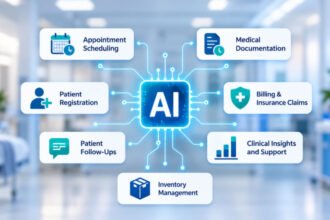
- Healthcare organisations using cloud platforms for telemedicine and secure patient data management
- Retail businesses using predictive analysis to understand customers and provide more personalised experiences
7 Cloud Computing Trends Businesses Should Know
1. AI and Machine Learning Integration
Artificial intelligence is becoming an important part of business technology. Companies are using AI and machine learning to automate routine work, analyse large amounts of information and support faster business decisions.
The source article projects that more than 50% of cloud services could be optimised for AI workloads by 2029. As cloud providers build more AI and machine learning tools directly into their platforms, businesses can use these capabilities without developing every system from scratch.
AI can help organisations identify unusual activity, understand business data and improve different stages of their operations.
2. Edge Computing
Edge computing processes data closer to where it is generated instead of sending everything to a central cloud location.
This can reduce delays and make applications respond faster. When combined with 5G, edge computing can support applications such as automated vehicles and other real-time systems.
It can be particularly useful for IoT devices and smart infrastructure, where quick responses are important.
3. Serverless Computing and Microservices Architecture
Serverless computing is changing the way businesses build and operate applications.
With a serverless model, the cloud provider takes care of much of the infrastructure management, maintenance and scaling. Developers can therefore concentrate more on building applications rather than managing servers.
Microservices also allow applications to be divided into smaller components. This gives businesses greater flexibility when updating or scaling individual parts of a system.
For small and medium-sized businesses in the Gulf, this approach can make it easier to expand into new markets while keeping infrastructure costs under control.
4. Cloud-Based Cybersecurity and Zero Trust
As more companies move their operations to the cloud, cybersecurity remains a major concern.
One important development is the growing use of Zero Trust Architecture. Instead of automatically trusting users or devices based on where they are connecting from, Zero Trust requires every access request to be verified.
This approach can provide stronger protection for business information and reduce the risks associated with storing and transferring data.
5. Industry Cloud Platforms
Businesses increasingly want cloud solutions that match the specific requirements of their industries.
Industry cloud platforms can include:
- Pre-defined compliance frameworks
- Data models designed for particular industries
- Industry-specific workflows and application programming interfaces
These solutions can make digital transformation easier by reducing unnecessary complexity. They also allow businesses to use cloud technology that is better suited to their regulatory and operational requirements.
6. Green Computing
Sustainability is becoming an increasingly important consideration for businesses.
Cloud providers are investing in energy-efficient data centres, renewable energy and carbon-neutral operations. Businesses can also benefit by adopting greener cloud strategies.
Potential benefits include:
- Lower environmental impact
- Better alignment with Environmental, Social and Governance (ESG) goals
- Greater trust among customers and stakeholders
As sustainability becomes more important in business decision-making, efficient cloud infrastructure can also become a competitive advantage.
7. Quantum Computing as a Service
Quantum computing is gradually moving beyond research laboratories and becoming available through cloud-based services.
Quantum Computing as a Service, or QaaS, allows businesses to explore quantum computing without purchasing expensive quantum hardware.
Possible applications include:
- Advanced cryptography
- Logistics and supply chain optimisation
- Drug discovery
- Material science
QaaS is still at an early stage, but it could eventually provide businesses with access to much greater computing capabilities and influence how companies approach complex problems and long-term planning.
Benefits of Cloud Computing for Businesses
Cloud computing can offer businesses several practical advantages:
- Cost efficiency
- Scalability and flexibility
- Business continuity
- Better collaboration
- Global accessibility
- Faster innovation
Conclusion
Cloud computing has become an important part of digital business strategy. Its role is expanding as companies adopt AI and machine learning, edge computing, stronger security models, industry-specific cloud platforms and more sustainable infrastructure.
AI is one of the major developments shaping this change. Instead of treating AI as a separate technology, businesses can increasingly use AI capabilities directly through cloud platforms for automation, data analysis and decision support.
At the same time, developments such as edge computing, Zero Trust security, green computing and Quantum Computing as a Service are creating new possibilities.
For businesses, the key is not simply moving everything to the cloud. The focus should be on choosing cloud technologies that match their operational needs, growth plans and security requirements.
Companies that make practical cloud investments today can build more flexible operations and remain better prepared as technology continues to evolve.