





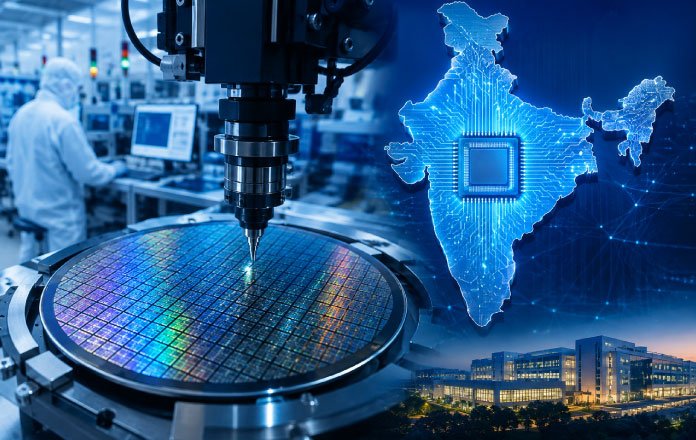
India’s semiconductor story is no longer limited to announcements and government approvals. Three semiconductor facilities have started commercial operations, while two more are expected to begin production by the end of 2026.
The development is significant for India’s electronics and manufacturing ambitions. The government has approved 12 semiconductor projects across six states, covering chip fabrication, packaging, testing and other parts of the semiconductor supply chain.
The larger goal is to build a domestic semiconductor industry and reduce the country’s dependence on imported chips.
Three Semiconductor Plants Are Already Operational
Three semiconductor facilities are now commercially operational in India.
These include:
- Micron’s ATMP facility
- Kaynes Semicon’s facility
- CG Power’s OSAT facility
The development shows that semiconductor projects in India are moving beyond the investment and construction stage.
The CG Semi facility in Sanand, Gujarat, is the latest addition. The facility, developed by CG Power along with Renesas Electronics and Stars Microelectronics, started commercial production in July 2026.
The project involves an investment of more than ₹7,600 crore. It will cater to sectors such as automobiles, two-wheelers and industrial applications, while also serving international markets.



Two more semiconductor facilities are expected to begin production before the end of 2026.
India Targets a $200 Billion Semiconductor Market.
India is not looking at semiconductors only as a manufacturing opportunity. The government wants to build capabilities across the entire chip supply chain.
The country is targeting a domestic semiconductor market worth $200 billion by 2035.
Demand for chips is rising across several industries, including:
- Artificial intelligence
- 5G and telecommunications
- Electric vehicles
- Automobiles
- Healthcare
- Defence
- Consumer electronics
Chips are an essential component in these products and technologies. Building domestic manufacturing capacity can help India support its growing electronics sector while reducing risks linked to overseas supply chains.
Semicon India Programme Lays the Groundwork
The government approved the Semicon India Programme in December 2021 with an outlay of ₹76,000 crore.
The programme was launched after global supply-chain disruptions exposed the risks of depending heavily on semiconductor production in other countries.
The government’s approach covers more than chip manufacturing. It includes the supporting industries needed to make semiconductor production work at scale.
These areas include:
- Chip design
- Semiconductor fabrication
- Packaging and testing
- Equipment and materials
- Specialty chemicals and industrial gases
- Logistics
- Skilled workforce
A semiconductor plant cannot operate in isolation. It needs equipment suppliers, materials, engineers, research institutions and logistics support. Building these capabilities within India will be important as the industry expands.
12 Projects Approved Across Six States
The government has approved 12 semiconductor projects across Gujarat, Uttar Pradesh, Punjab, Assam, Odisha and Andhra Pradesh.
The projects cover different parts of the semiconductor industry, including:
- One silicon fabrication facility
- One compound semiconductor fab with packaging
- One Micro LED Display GaN fab with packaging
- Nine ATMP/OSAT facilities
The three operational plants provide an early base for this manufacturing network.
Gujarat has emerged as one of the main centres for semiconductor investment, with several major projects coming up in the state. The CG Semi facility in Sanand adds another significant manufacturing operation to the state’s semiconductor cluster.
India Has an Existing Strength in Chip Design
India’s semiconductor ambitions are not starting from scratch.
The country already has a sizeable semiconductor design workforce, accounting for nearly 20% of global semiconductor design talent.
The government is also supporting chip-design companies through the Design Linked Incentive scheme.
So far, 103 applications for electronic design automation tools and 24 chip-design projects have been approved. Fifteen companies have also received venture capital support.
Skill development is another major part of the semiconductor programme.
Under the Chips to Startup initiative, electronic design automation tools have been provided to 320 academic institutions. More than 68,000 students have received training, while a semiconductor curriculum has been introduced in more than 500 engineering colleges.
Semicon India 2.0 Broadens the Focus
The next phase, Semicon India Programme 2.0, will take the focus beyond setting up manufacturing plants.
The programme covers six key areas:
- Chip design
- Semiconductor equipment and materials
- Fabrication facilities
- Advanced packaging
- Research and development
- Talent development
The aim is to increase domestic capabilities in areas such as semiconductor equipment and materials.
This could also create opportunities for Indian MSMEs. As large semiconductor companies establish operations in the country, smaller businesses can potentially become suppliers and connect with global semiconductor supply chains.
Global Partnerships Continue to Play a Role
India is also working with international partners to build its semiconductor capabilities.
The country has partnerships with nations and regions including the United States, Japan, Singapore, the Netherlands, Germany and the European Union.
Several global companies have also announced investments or collaborations in India. These include Applied Materials, AMD, Lam Research, KLA and Microchip Technology.
Such partnerships can give Indian companies and institutions access to technology, equipment, technical expertise and international semiconductor networks.
India’s Semiconductor Push Enters a New Phase
India’s semiconductor industry is now moving from policy announcements to actual manufacturing.
Three facilities are already producing commercially, while two more are expected to start operations by the end of 2026.
The government has also created a broader pipeline covering chip fabrication, packaging, testing, design, research and skill development.
The target is ambitious: a $200 billion domestic semiconductor market by 2035.
The next challenge will be building a supply chain that can support this growth. India will need more local suppliers, skilled engineers, advanced packaging capabilities, research facilities and semiconductor equipment.
If these areas develop alongside manufacturing, India could establish a stronger position in the global semiconductor industry and make chips an important part of its long-term manufacturing strategy.