





AI Voice Agents: How They Work, Benefits, and Business Applications
Businesses handle hundreds or even thousands of customer calls every day. Answering every call on time, resolving common queries and keeping customer records updated can put considerable pressure on support teams. AI voice agents offer a way to manage many of these tasks without depending entirely on human representatives.
These systems use artificial intelligence to understand spoken requests, respond to callers, and carry out specific tasks. Businesses can use them for customer support, appointment bookings, sales follow-ups, payment reminders, and other routine activities.
What Are AI Voice Agents?
An AI voice agent is a software system that communicates with people through spoken language. It listens to a request, works out what the caller needs, and provides a relevant response. Depending on its capabilities and integrations, it can also retrieve information or complete tasks using business applications.
Consider a customer calling a company to check an order status. Instead of waiting for a support executive, the customer can ask the question directly. The voice agent can retrieve the order details from an authorised system and share the update over the call.
Advanced voice agents can also handle follow-up questions and keep track of the conversation. However, their ability to manage complex requests depends on the technology, information and tools available to them.
How Do AI Voice Agents Work?
An AI voice agent combines several technologies to understand a caller and respond appropriately.
- Speech recognition: The system processes the caller’s speech and converts it into information the AI can understand. Some newer systems process audio directly.
- Understanding the request: The AI identifies what the caller wants and picks out important details, such as an order number or preferred appointment time.
- Using conversation context: The agent considers earlier messages and relevant information so that the caller does not have to repeat every detail.
- Completing the task: If the required integrations and permissions are available, the agent can check records, schedule appointments, or update information.
- Responding to the caller: It generates a spoken answer and continues the conversation. If it cannot resolve the issue, it can pass the call to a human representative.
There are two common ways to build these systems. A speech-to-speech model processes audio directly, while a chained system uses separate components for speech recognition, AI processing, and voice generation. Each approach has its own advantages, depending on response speed, control, and the requirements of the business.
AI Voice Agents vs. Traditional IVR Systems and Chatbots
Traditional Interactive Voice Response (IVR) systems ask callers to select options from a menu. For example, a customer may need to press one for sales, two for support, or three for billing. This works for simple requests, but customers can become frustrated when their problem does not fit the available options.


Text-based chatbots offer another way to answer questions, but customers must type their requests.
AI voice agents take a more flexible approach. Callers can explain their problems naturally, ask additional questions, and complete supported tasks through conversation.
The main differences are:
- Interaction: IVR systems rely on menus, while AI voice agents support more natural conversations.
- Understanding: Voice agents can interpret open-ended spoken requests instead of depending only on fixed commands.
- Context: Advanced agents can use relevant details from earlier parts of a conversation.
- Task completion: With suitable integrations, they can access business information and carry out approved actions.
- Human assistance: They can transfer complicated cases to a support representative when necessary.
The important point is that not every voice bot offers these capabilities. A system’s usefulness depends on how well it understands requests and what it can actually do.
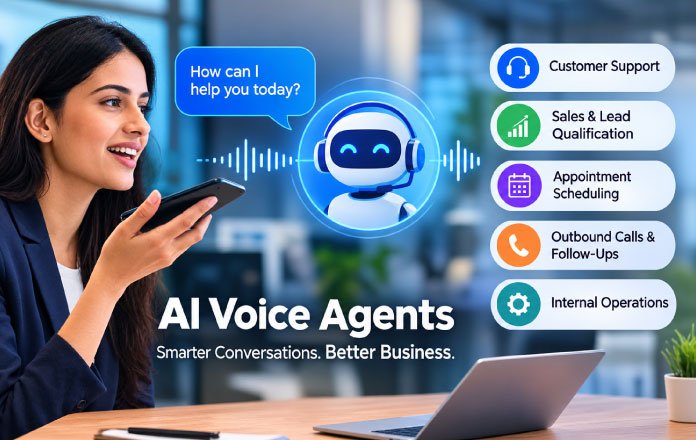
Key Business Applications of AI Voice Agents
1. Customer Support
Customer support teams spend a significant amount of time answering similar questions. An AI voice agent can handle routine enquiries about orders, account details, delivery updates and service information. More complicated complaints can be transferred to a human executive.
2. Sales and Lead Qualification
Sales teams can use voice agents to contact potential customers, ask initial questions, collect relevant details and identify leads that need further attention. This allows sales representatives to spend more time on prospects who are ready for a detailed discussion.
3. Appointment Scheduling
Clinics, service centres, consultants and other appointment-based businesses can use voice agents to manage bookings, confirmations, rescheduling, and reminders. When connected to a scheduling system, the agent can check available slots and update appointments.
4. Outbound Calls and Follow-Ups
Businesses can automate routine follow-up calls, payment reminders, service notifications and customer feedback requests. These tasks are particularly suitable for automation when the conversation follows a clear process and the business has appropriate consent and compliance measures in place.
5. Internal Business Operations
Voice agents can also help employees find information, raise IT support requests, check task statuses, and access internal resources. The system must have permission to access the relevant applications and company information.
Benefits of AI Voice Agents for Businesses
For businesses managing a large volume of calls, voice agents can improve how routine communication is handled.
Extended availability: They can respond to supported requests outside normal office hours helping customers who need assistance after business hours.
Less repetitive work: Employees spend less time answering the same questions and can focus on cases that need investigation or personal attention.
Consistent responses: Agents can follow approved processes and provide standard information across customer interactions.
Handling more calls: Businesses can configure agents to manage higher call volumes without increasing the support team at the same rate.
Connections with business software: Integrations with CRM platforms, helpdesks, calendars, and customer databases allow agents to retrieve information and complete specific tasks.
The results will vary from one business to another. Good integration, accurate information, effective testing, and clear escalation procedures all affect performance.
AI Voice Agents vs. Human Agents: Finding the Right Balance
AI voice agents are well suited to routine conversations, but they cannot replace human judgment in every situation. A customer dealing with a complicated complaint, a sensitive issue or an unusual request may need a person who can assess the situation and respond appropriately.
Businesses should decide which tasks can be automated and which require human involvement. Voice agents can handle common enquiries and straightforward workflows while human representatives take over when a case needs closer attention.
This arrangement helps businesses improve efficiency without making customer service feel impersonal.
Integrating AI Voice Agents With Business Systems
A voice agent becomes more useful when it can work with the software a business already uses. Through APIs and supported integrations, it can access authorised information and carry out specific actions.
Common integrations include:
- Customer relationship management (CRM) platforms
- Helpdesk and ticketing systems
- Appointment calendars
- Order management software
- Enterprise resource planning (ERP) systems
- Company knowledge bases and databases
- Telephony and contact centre platforms
For instance, an agent speaking to a prospective customer could collect contact details, create a lead record in the CRM and schedule a follow-up call. These actions depend on the available integrations and the permissions granted to the agent.
Businesses should also protect customer information, restrict access to sensitive systems, and maintain clear records of automated actions.
What Should Businesses Consider Before Implementation?
Choosing a voice agent is only one part of the process. Businesses should first identify the problem they want to solve and decide how success will be measured.
Before deployment, consider the following:
- Select a clear use case, such as answering routine support calls or scheduling appointments.
- Choose an AI and voice architecture that suits the expected call volume and response requirements.
- Connect the systems needed to retrieve information or complete tasks.
- Set access permissions, security controls, and privacy safeguards.
- Define when the agent should transfer a call to a human representative.
- Test different accents, background noise, interruptions, and unexpected questions.
- Measure accuracy, response time, successful task completion, and customer satisfaction.
- Review performance regularly and correct problems as they arise.
A small pilot project can help a business understand what works before introducing voice agents across more departments.
The Future of AI Voice Agents
AI voice agents are moving beyond answering basic questions. With suitable technology and integrations, they can manage longer conversations, retrieve information, and complete defined tasks during a call.
These improvements could create new opportunities in customer support, sales and internal operations. However, businesses still need to consider reliability, data protection, integration quality, and the role of human support.
The best starting point is straightforward: choose a repetitive task, test a voice agent against clear performance targets and expand its responsibilities when it delivers dependable results.
Frequently Asked Questions
1. What is the main purpose of an AI voice agent?
An AI voice agent understands spoken requests and responds to callers. It can also perform tasks such as answering routine questions, checking order details, and scheduling appointments when the required integrations are available.
2. Can AI voice agents handle inbound and outbound calls?
Yes. They can answer incoming calls and make outbound calls for approved activities such as reminders, follow-ups, lead qualification and service notifications.
3. Can AI voice agents replace customer service representatives?
They can manage many routine interactions but human representatives remain important for complex complaints, sensitive situations and requests that require judgment. A combination of automated and human support is often more practical.
4. Can AI voice agents connect with existing business software?
Yes. Depending on the platform, they can integrate with CRM systems, calendars, helpdesks, databases and other applications through APIs and supported connectors.
5. How long does implementation take?
The timeline depends on the complexity of the workflow, integrations, security requirements and testing. A basic proof of concept may take relatively little time, while an enterprise deployment requires more extensive preparation and validation.
6. Which industries can use AI voice agents?
Healthcare, banking, insurance, retail, telecommunications, logistics and real estate are among the industries that can use voice agents for suitable customer communication and internal workflows.