


Artificial intelligence is no longer something that belongs only to technology companies. It is now becoming a practical part of the travel and tourism industry. From planning a holiday to checking into a hotel, AI is helping travel companies understand customers better, improve services and manage daily operations more efficiently.
For travellers, one of the biggest changes is personalization. AI can study customer preferences and past behaviour to recommend destinations, hotels, activities and travel plans. Instead of showing the same options to everyone, travel businesses can provide suggestions based on what a particular traveller is looking for.
AI-Powered Travel Planning
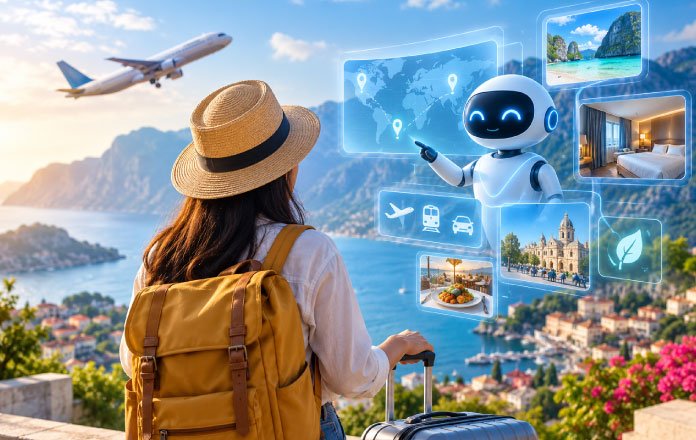
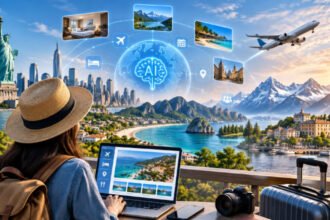
Generative AI is taking travel planning a step further. A traveller can provide information such as destination, budget, preferred transport, accommodation and activities, and an AI-powered travel assistant can help create a complete itinerary.
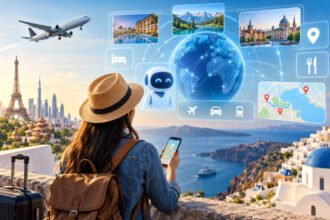
These systems can also support destination discovery, booking information, language translation and personalized recommendations. Strategy& notes that future AI travel concierges could bring flights, hotels, ground transportation and tours together into customized travel packages.
This could make travel planning much easier, particularly for people who do not want to spend hours comparing different websites and services.
Better Customer Service with AI
Chatbots and virtual assistants are among the most visible uses of AI in tourism. They can answer common questions, provide travel information, support reservations and remain available outside normal business hours.
Natural language processing allows these systems to understand and respond to human language. This is particularly useful for international tourism because AI-based services can support communication in multiple languages. Voice recognition can also allow travellers to interact with digital assistants without typing.
However, AI does not necessarily mean removing people from customer service. The bigger opportunity is to allow employees to spend less time handling repetitive questions and more time dealing with situations that require human judgement and personal attention.

Personalised Hotel and Travel Experiences
Hotels and travel companies are using AI to understand customer behaviour and preferences. This information can help businesses recommend suitable rooms, activities, restaurants and travel services.
For example, AI can analyse previous choices and current requirements to provide more relevant suggestions. Such personalization can improve customer satisfaction and create opportunities for cross-selling and upselling.
The same approach can also be used in marketing. Instead of sending identical promotions to a large audience, businesses can use AI to identify different customer segments and create more targeted campaigns.
Predictive Analytics and Dynamic Pricing
Another important application of AI is predictive analytics. Travel companies deal with huge amounts of information, including customer demand, booking patterns, competitor prices and market conditions.
AI can process this information to identify trends and help businesses make better decisions. Online travel companies can analyse demand and competitor pricing in real time and adjust rates according to market conditions. Hotels can use similar systems for room pricing, inventory and revenue management.
AI-based demand forecasting can also help businesses prepare for changes in customer demand instead of simply reacting after the change has happened.
AI for Tourism Operations
AI is not limited to the customer-facing side of tourism. It is also being used behind the scenes.
Travel and hospitality businesses can use AI to support:
- Booking and reservation management
- Check-in processes
- Scheduling
- Inventory management
- Maintenance planning
- Demand forecasting
- Revenue management
- Baggage and airport operations
- Customer communication
Automating repetitive activities can reduce manual work, improve operational efficiency and reduce the possibility of human error.
Improving Safety and Managing Crowds
Safety is another area where AI can play an important role. Computer vision and other AI-supported systems can monitor real-time information, identify potential security concerns and support crowd management.
At airports, tourist attractions and transportation hubs, AI-based object detection and facial recognition can support security and operational activities. AI can also help destinations understand tourist flows and manage crowded areas more effectively.
Better crowd management can improve the visitor experience while also helping destinations use their infrastructure and resources more efficiently.
AI and Sustainable Tourism
AI can also contribute to more sustainable tourism. Predictive systems can help businesses and destinations understand visitor demand and prepare for changes in tourist flows.
AI can support better resource allocation and help destinations manage crowded locations. Predictive analytics can also be used to anticipate factors such as climate-related changes and other disruptions, helping tourism businesses prepare for changing conditions.
Emerging technologies such as augmented reality and virtual reality can further support tourism by allowing potential visitors to experience or explore destinations digitally before deciding to travel.
Real Examples of AI Adoption
AI adoption is already visible across major hospitality businesses. DATAFOREST highlights examples involving Marriott, Hilton, IHG, AccorHotels and Radisson, covering areas such as personalization, pricing, customer interaction, marketing and revenue management.
Strategy& also points to Singapore’s tourism ecosystem, where public-private collaboration has been used to develop and test new AI applications. Millennium Hotels and Resorts, for example, developed an AI-based in-room housekeeping concierge through the Singapore Tourism Board’s accelerator programme.
These examples show that AI is moving beyond experiments and into practical tourism operations.
Challenges Businesses Cannot Ignore
AI brings clear advantages, but tourism companies also need to deal with its risks.
Data privacy is one of the biggest concerns because AI systems often depend on customer information. Businesses must protect personal data and make sure customers understand how their information is being used.
There is also the possibility of bias in AI systems. Poorly designed algorithms could produce unfair recommendations or treatment. Employment is another concern because automation may change some traditional tourism roles.
Businesses therefore need to invest not only in technology but also in employee training, responsible AI practices, cybersecurity and human oversight.
What Tourism Businesses Should Do Next
For companies planning to adopt AI, starting with technology alone is not enough. Strategy& recommends a structured approach: define clear objectives, assess digital readiness and resources, launch pilot projects, and then monitor results before scaling successful initiatives.
A practical approach is to:
- Identify a specific business problem that AI can solve.
- Check whether the required data and digital infrastructure are available.
- Train employees to work effectively with AI tools.
- Start with a small pilot project.
- Measure customer satisfaction, efficiency and business results.
- Scale applications that demonstrate clear value.
The Road Ahead for AI in Tourism
AI is changing travel at almost every stage, from discovering a destination and planning an itinerary to booking accommodation, managing hotel operations and improving visitor safety.
The real opportunity is not simply to automate as many tasks as possible. It is to use AI where it can make travel more convenient, services more personal and tourism operations more efficient.
At the same time, the industry must keep the human element intact. Privacy, fairness, cybersecurity, employee skills and responsible decision-making will be just as important as the technology itself.
For travel and hospitality businesses, the message is straightforward: AI is becoming part of everyday tourism. The companies that learn how to combine AI with good data, skilled employees and human service will be better placed to benefit from the next phase of travel innovation.