




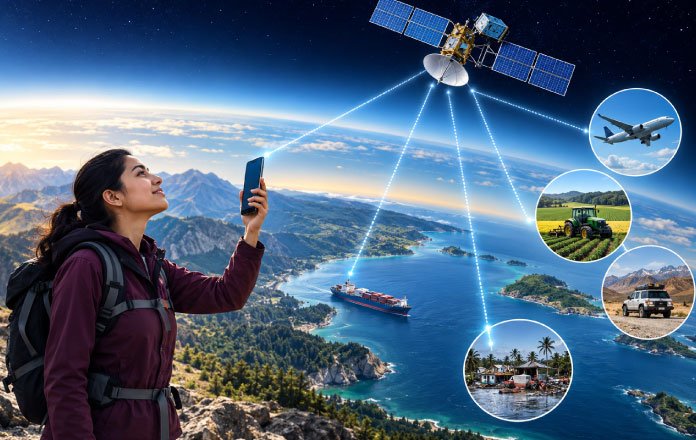
Imagine travelling through a remote mountain area, crossing an ocean or driving through a region with no mobile tower nearby. Your smartphone may still be able to connect to a satellite.
That is the basic idea behind Direct-to-Device (D2D) satellite connectivity. Instead of depending only on terrestrial mobile towers, compatible smartphones, IoT devices and other equipment can communicate directly with satellites.
D2D is becoming an important part of the connectivity ecosystem because it can extend mobile coverage to places where traditional networks are difficult or expensive to build. It can also provide an additional layer of connectivity when terrestrial networks go down.
How satellite D2D works
Satellite D2D can use different spectrum and network approaches.
One approach uses mobile-satellite service spectrum for communication between satellites and devices. Another approach allows satellite operators to work with mobile network operators and use spectrum associated with terrestrial mobile networks.
This second model is particularly interesting because it can extend an existing mobile network beyond the reach of its towers. The user does not necessarily need a separate satellite terminal.
The development of 3GPP standards has also helped bring satellite and terrestrial networks closer together. Non-terrestrial network technology provides a framework for integrating satellite connectivity with modern mobile networks.
Where D2D can help
Emergency communication is one of the clearest applications for D2D.



When floods, earthquakes, cyclones or other disasters damage terrestrial infrastructure, satellite connectivity can provide another communication route. It can also help people stay connected in locations such as deserts, mountains, oceans and other remote areas.
The technology has applications beyond smartphones as well.
IoT is becoming a major opportunity for satellite D2D. Devices used in agriculture, energy, transportation, logistics, mining and utilities can remain connected even when conventional cellular coverage is unavailable.
Viasat’s 2026 research highlights growing interest in D2D among industrial IoT users. The company found strong planned adoption of D2D devices for applications including vehicle tracking, route optimisation, water infrastructure monitoring, wellhead monitoring, crop storage and automated haulage.
D2D is moving beyond emergency messaging
The first wave of satellite-to-phone services has largely focused on messaging and emergency communication.
The next stage is broader connectivity, including voice and higher-bandwidth data services.
This is where the commercial opportunity becomes much bigger. Satellite operators and mobile network operators can work together to extend network coverage without building terrestrial infrastructure everywhere.
Analysys Mason has projected substantial growth in the satellite D2D market, with service revenue potentially approaching $48.6 billion by 2032.
The market will depend on several factors, including satellite capacity, technology development, industry standards and partnerships between satellite operators and mobile network operators.
Regulation is a major challenge
Technology alone will not determine how quickly D2D grows. Regulation will also play a major role.
Spectrum is one of the biggest issues.
When satellites use spectrum associated with terrestrial mobile networks, regulators need to make sure satellite signals do not interfere with existing networks. The situation becomes more complicated because satellite signals can cross national borders.
Licensing is another important consideration. Satellite services and terrestrial mobile networks have traditionally operated under different regulatory frameworks. D2D brings these two areas closer together.
Regulators also need to consider emergency services, quality of service, privacy, consumer transparency, lawful interception and universal service obligations.
Users should know when their device is using satellite connectivity and what limitations or charges may apply.
Countries are creating D2D frameworks
Regulators in several countries have already started working on frameworks for satellite D2D.
The United States introduced its Supplemental Coverage from Space framework to enable satellite connectivity using terrestrial mobile spectrum while protecting existing networks.
Other countries, including Brazil, Australia and Canada, have also taken steps towards supporting or testing satellite-based supplemental mobile coverage.
International coordination remains important because satellite signals do not stop at national borders. Work by international bodies and the continued development of 3GPP standards will therefore influence how D2D services develop globally.
Mobile operators have an important role
D2D is not only a business opportunity for satellite companies.
Mobile network operators can use satellite connectivity to extend their existing coverage and offer services in locations where terrestrial networks cannot reach.
For smartphone manufacturers and other device makers, D2D can add another connectivity option to their products.
Skylo has argued that satellite D2D is already commercially viable and that mobile operators and device manufacturers should adopt the technology to strengthen their services and create new revenue opportunities.
Industrial demand is also growing. Viasat’s research found that many organisations are considering D2D as an alternative or additional option for their existing IoT connectivity.
The future will be a hybrid network
Satellite D2D is not expected to replace mobile towers.
Instead, its real strength is in working alongside terrestrial networks.
A future smartphone, vehicle or IoT device could automatically use a terrestrial network when one is available and switch to satellite connectivity when it moves outside normal coverage.
That combination could make connectivity more reliable and extend network reach considerably.
The road ahead still has challenges. Spectrum availability, licensing, standards, satellite capacity and commercial partnerships all need to develop together.
But the direction is clear. Satellite D2D can help connect remote communities, support emergency communication, expand industrial IoT and provide connectivity in places where traditional networks cannot easily reach.
For consumers and businesses, the biggest change may be simple: losing mobile coverage may no longer always mean losing connectivity.