




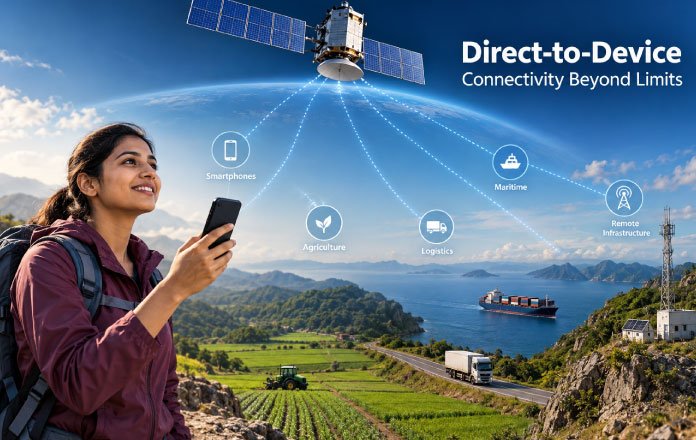
Imagine travelling through a remote area where there is no mobile tower nearby. Normally, your phone would lose network coverage. Direct-to-Device (D2D) technology is trying to solve this problem by allowing compatible devices to communicate directly with satellites.
The technology is attracting attention in both the telecom and satellite industries. It could help smartphones, IoT sensors and other connected devices stay in touch in places where traditional mobile networks cannot reach.
What is Direct-to-Device?
Direct-to-Device, commonly called D2D, allows a compatible device to communicate directly with a satellite without depending on a nearby cellular tower.
Many D2D systems use Low Earth Orbit (LEO) satellites. These satellites operate much closer to Earth than traditional geostationary satellites. FOSSA puts the operating altitude of LEO satellites at roughly 500 to 2,000 kilometres.
For users, the basic idea is simple: if there is no mobile tower available, the satellite can provide another route for communication.
D2D is not limited to mobile phones. It can also be used for IoT devices such as sensors, trackers and machines operating in remote locations.
How Does D2D Work?
A normal mobile phone connects to a nearby tower. The tower then links the phone to the wider telecom network.
With D2D, the satellite takes the place of that ground-based connection.



A typical D2D system involves:
- LEO satellites that receive and send signals
- Compatible phones, sensors or other devices
- Communication protocols designed to handle satellite connectivity
FOSSA says LEO satellites can help reduce latency because of their lower altitude. Some devices may need hardware changes, while others can work with existing hardware, depending on the service.
There is another point that is important here. D2D is a capability, not a single technology standard. Ground Control explains that D2D can use proprietary technology or standards such as NB-IoT and LTE Cat 1.
So, not every satellite service described as D2D will work in exactly the same way.
Where Can D2D Be Used?
The possible uses are quite practical.
Emergency Communication
Natural disasters can damage mobile towers and other network infrastructure. In such situations, satellite connectivity can provide another way to send messages or alerts.
Rural and Remote Areas
Large parts of the world still have limited mobile coverage. D2D can help extend connectivity to remote communities and locations where building traditional telecom infrastructure is difficult.
Agriculture
Farmers can use connected sensors to monitor soil moisture, crops and weather conditions. Satellite connectivity becomes particularly useful when these farms are far away from cellular networks.
Logistics and Tracking
Trucks, ships and containers often travel through areas where mobile coverage is inconsistent. Satellite-connected tracking devices can continue sending information when terrestrial networks are unavailable.
Critical Infrastructure
Remote power equipment, pipelines and other infrastructure can also use connected sensors to send operational information from difficult locations.
What Are the Benefits?
The biggest advantage of D2D is coverage.
A satellite does not need a mobile tower in every location it serves. This makes the technology useful for remote areas, emergency situations and large-scale IoT deployments.
Other potential benefits include:
- Wider connectivity in areas without mobile coverage
- An additional communication option when terrestrial networks fail
- Support for remote IoT sensors
- Lower-power connectivity for certain IoT applications
- Better tracking of assets operating outside normal network coverage
But D2D should not be viewed as a replacement for mobile networks. It is more useful as an additional layer of connectivity.
What Are the Challenges?
D2D still has several limitations.
First, device compatibility remains an issue. Some services require dedicated hardware, while others are being developed to work with standard smartphones.
IoT presents an even bigger challenge. Ground Control notes that pure D2D IoT remains limited and that devices need a suitable view of the sky for reliable satellite communication. Sensors installed inside machinery or underneath panels may therefore face difficulties.
Another consideration is the amount of data a device needs to send. Standards-based satellite IoT services can be suitable for applications that send small amounts of data occasionally. Applications requiring higher data volumes or near-real-time communication may still need established proprietary satellite services.
What Does D2D Mean for India?
India is also expected to see strong growth in the D2D market.
According to MarketsandMarkets, India’s D2D market was valued at around $5.8 million in 2025 and is projected to reach approximately $331.9 million by 2030, representing a reported CAGR of 124.8%. The report links this growth to areas including aerospace, defence, satellite communications, IoT and government investment.
For India, the technology could have applications ranging from remote connectivity and agriculture to logistics, defence and critical infrastructure.
Will D2D Replace Mobile Networks?
Probably not.
The more realistic future is a combination of cellular and satellite networks. A phone could use a normal mobile tower when one is available and potentially switch to satellite connectivity when terrestrial coverage disappears.
For IoT companies, the same principle could help devices continue sending important information from remote locations.
D2D is still developing, and device support, satellite coverage, spectrum, hardware and network agreements will determine how quickly it becomes widely available.
For now, the biggest promise of D2D is fairly straightforward: when the mobile tower ends, the satellite could take over.