





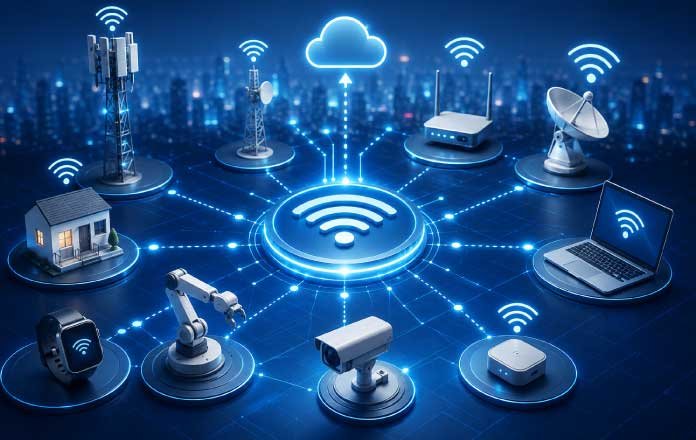
The Internet of Things (IoT) has come into its own as a disruptive technology, enabling billions of devices to sense, interact, and behave intelligently. Starting with intelligent home and wearable technologies, and moving through industrial automation, smart cities, healthcare, and agricultural solutions, wireless communication enables a wide range of IoT applications. By no means is wireless communication in the IoT driven solely by a single technology; instead, it is propelled by the entire technology chain, including semiconductors, communication technologies, networks, and telecom technologies. This article provides insights into the technologies that drive wireless communication in the IoT.
Semiconductor Technology: Semiconductors are essentially the backbone of all IoT nodes. Chip technology developments have enabled smaller, less expensive, and power-conservative devices that support wireless communication.
System-on-Chip (SoC): Modern IoT devices are commonly reliant on System-on-a-Chip (SoC) technology. Microcontrollers with wireless communication are very important for simplifying, reducing costs, and improving power consumption in devices. Low-power microcontrollers are especially important for battery-powered IoT devices located in remote, hard-to-access areas.
Low Power & Energy Efficient Design: The efficient use of energy is a hallmark of the Internet of Things and is enabled by innovations such as ultra-low-power transistors, sleep modes, and energy harvesting. Near-threshold voltage and Power Management Integrated Circuits would allow devices to run for several years on a single battery.
Radio Frequency (RF) & Analog Components: In wireless communication for IoT, Radio Frequencies (RF) and analog components, including transceivers, antennas, and amplifiers, play a significant role. As a result of advancements in RF integration/circuitry, communication is possible even in small devices.
Short-Range Wireless Communication Technologies: Short-range wireless communication systems have been widely adopted for IoT applications where devices have a limited range.
Bluetooth & Bluetooth Low Energy (BLE): Bluetooth Low Energy (BLE) has emerged as a BlueTech core technology for short-range communication in the IoT. This technology requires less power, is widely supported by smartphones, and now has faster data rates. It has now been extended to support a mesh network topology, further increasing its applications in bright lighting.
Wi-Fi & Wi-Fi HaLow: Wi-Fi is also advancing to meet the requirements of the Internet of Things. Even though standard Wi-Fi supports high data transfer speeds, newer Wi-Fi variants such as Wi-Fi HaLow, based on IEEE 802.11ah, operate at lower frequencies to enable a more extended range and lower power consumption.



Zigbee & Thread: Zigbee and Thread are mesh networks with low power consumption and support reliable communication between devices and between devices and networks. They are used in home automation and smart home solutions for energy management and industrial control.
Long-Range Wireless IoT Connectivity: For wide-area communication, long-range wireless solutions are essential.
Low-Power Wide Area Networks (LPWAN): LPWAN technologies, including LoRaWAN and Sigfox, have been designed to enable long-range device-to-device communication with minimal power consumption. Data transmission speeds are lower and thus preferred for applications such as smart metering and tracking. The advantage is that it operates on unlicensed bands, making it less expensive to implement.
Cellular IoT Technologies: However, cellular networks have advanced to support dedicated IoT standards such as NB-IoT (Narrowband IoT) and LTE-M. Such solutions leverage the existing cellular network infrastructure to deliver secure, scalable, and reliable connectivity. They are ideal for IoT applications focused on quality of service.
Role of 5G Connectivity in IoT
The arrival of 5G is a significant milestone in wireless IoT connectivity. Compared to past generations, it is envisioned to support a broad set of use cases, including both massive IoT and ultra-relaxed, low-latency applications.
Massive Machine-Type Communications (mMTC): 5G supports massive machine-type communication. This means that millions of machines or devices can connect within a limited geographic area. This is necessary for the creation of smart cities and the Internet of Things.
Ultra Reliability Low-Latency Communications: For mission-critical IoT applications such as autonomous vehicles, remote surgery, and industrial robots, ultra-low latency and high reliability are essential. This is where 5G URLLC technology comes into play, offering new possibilities for real-time IoT applications.
Network Slicing & Edge Computing: The 5G network will also support network slicing, enabling telecom companies to offer personalised, optimised virtual networks for specific IoT use cases. With edge computing, IoT data processing will occur closer to devices, enhancing security and bandwidth efficiency.
Telecom Infrastructure & Cloud Integration: Telecom networks, clouds, or communication platforms are the key elements that make up the entire IoT system. The majority of today’s telecom networks support large-scale device management, data forwarding, and security measures as essential functions.
IoT Platforms & Device Management: Telecommunications companies are increasingly delivering IoT platforms that provision, manage, and maintain devices and oversee firmware updates. Platforms are making it easier for large IoT implementations to succeed.
Security Technologies: As there are several connected devices, having robust security to protect against cyber threats is paramount to their success and adoption by the mainstream user community. Examples of such technologies include hardware-based security modules, secure boot, encryption methods, and network authentication protocols.
A variety of technologies, including semiconductor breakthroughs, low-power chips, new wireless communications, and the future telecom infrastructure, are fueling the demand for wireless IoT connectivity. The increasing use of IoT applications across industries will be accompanied by the convergence of semiconductors and telecommunications infrastructure, shaping the future of IoT connectivity. The future might bring innovations in 5G communications, edge computing, and low-power semiconductors, among others, that will increase the intelligence of IoT infrastructure and make wireless a key component of the digital economy.