




The fourth industrial revolution, popularly known as Industry 4.0, is a paradigm shift in how industries compete and produce. Unlike past industrial revolutions that emphasised mechanisation, electrification, or automation, Industry 4.0 is all about data. Data is the backbone of Industry 4.0. The key technology that supports data collection on this platform is the Internet of Things (IoT). The technology that has the potential to make various devices and systems aware of their surroundings through sensing and data exchange is the backbone of Industry 4.0. The key functionality of the IoT is that it serves as the primary driver of data.
Exploring the Concept of IoT in Light of Industry 4.0
The IoT refers to a network of connected devices with sensors that collect and transmit their data to the Internet and other devices. In an industry setting, IoT comprises smart, connected machines, wearables, and smart infrastructure devices that generate large amounts of data.
In the context of Industry 4.0, IoT applications do not operate alone. Instead, they integrate with other advanced technologies such as artificial intelligence, big data analytics, cloud computing, digital twins, and cyber-physical systems. IoT serves as the primary source of real-time data that drives other technologies, facilitating industries’ shift towards prediction and prescription.
IoT: The Nerve-Center of Real-Time Data Acquisition
The traditional industrial system was characterised by periodic data collection and manual reporting, resulting in delays and incomplete data. The emerging technology of IoT has dramatically changed this paradigm by enabling continuous, real-time data collection. Sensors can be installed in equipment to monitor parameters such as temperature, pressure, vibration, energy usage, and production speed.
Real-time visibility enables organisations to identify anomalies and react before a potential problem becomes a reality. Thus, IoT enables faster, more accurate decision-making. The IoT transforms operational data into a valuable resource for efficiency, quality, and innovation.
Improvement in Operational Efficiency & Productivity
One of the key roles of IoT technology in Industry 4.0 is in optimising services. In their pursuit of efficiency, businesses today use IoT technology to identify opportunities for improvement by monitoring and analysing data generated by interconnected machines within their organisations.
Another critical use case for predictive maintenance. Instead of sticking to a set maintenance routine, IoT enables equipment to check in real time how it is performing, predicting when a potential failure could occur, thus allowing minimal unplanned downtime, improving equipment life, and decreasing maintenance expenses. Hence, it provides increased productivity and equipment reliability.
Driving Smart Manufacturing & Automation
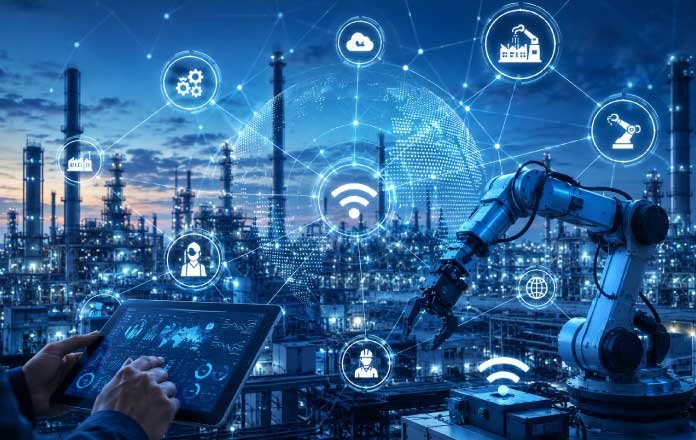
IoT applications play a significant role in the creation of smart factories. This is one of the major constituents or cornerstones of Industry 4.0. In a smart factory setup, the machines can communicate directly with each other and with the control system independently. This leads to automatic production lines.


For example, IoT-based solutions can self-regulate their production variables to ensure consistent product quality or seamlessly switch among different product models without any human intervention. IoT, interwoven with robotics and AI, can help achieve flexible, personalised, and highly automated production for mass customisation while being efficient.
Enabling Data-Driven Decision Making
IoT doesn’t only provide the advantage of collecting raw data, but also relies on the intelligent use of already processed data to generate valuable insights through the data mining process. IoT data is highly valuable when processed by sophisticated analytics platforms that provide insights into machine performance or customer behavior, enabling you to take action.
The managers will be able to make strategic decisions based on these learnings, including optimising inventory, improving energy efficiency, and optimising procedures. Strategic decision-making will no longer depend on experience; decisions will be based on facts that enhance competitiveness.
Supply Chain & Asset Management Transformation
IoT is also bringing a paradigm shift in supply chain management. End-to-end supply chain (also known as the value chain) visibility is now possible through the IoT. It is possible to track product flow in real time using connected tracking devices.
In the asset-intensive sector, the IoT helps manage assets efficiently by monitoring usage and performance across varied locations. Organisations get an overall idea of the assets they hold.
Challenges & Issues Regarding IoT Implementation
Although it has many benefits, adopting IoT in Industry 4.0 poses various challenges. Cybersecurity threats stand out among these issues, particularly data security, as more devices are connected to the network, expanding the attack surface. There should be strong cybersecurity in Industry 4.0.
Moreover, the organisation must also handle data integration, interoperability, and skill gaps. Handling a significant amount of data from the IoT requires investment in infrastructure and worker training. Strategy and proper governance are essential for the successful execution of IoT.
IoT: The Data Engine for the Future Industry
As industries accelerate their digital transformation, IoT appears poised to become the data backbone of Industry 4.0. IoT is thus shaping Industry 4.0 by enabling real-time data collection, enhancing efficiency, and enabling smart automation and data-driven decision-making. Those who will benefit the most from the successful integration of IoT and Industry 4.0 will advance towards improved productivity and innovation, and will also become the backbone of an intelligence-driven, connected world of industry and commerce that will soon define this world. IoT will play an even more critical role in this area.