





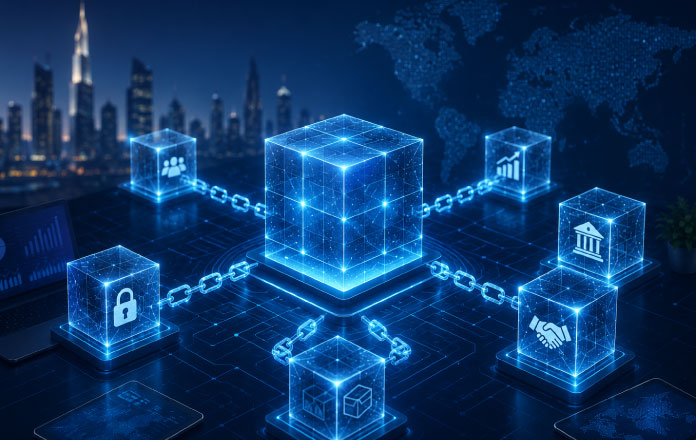
Blockchain, known only through terminology related to cryptocurrencies, is swiftly becoming a game-changer in how businesses work. Its potential extends well beyond digital currencies heralding a new age of transparency, efficiency, and trust across many other sectors. Whether it is for streamlining global supply chains or empowering self-executing smart contracts, blockchain is increasingly seen as a cornerstone of the future enterprise.
Learning the Business Use of Blockchain
Fundamentally, blockchain is a distributed digital ledger in which encoded transactions are sequentially recorded across a decentralized computer network. What’s groundbreaking is its blend of decentralization, immutability, and transparency. When information is written to the blockchain, it cannot be modified unless there is consensus across the whole network. This cuts out the mediators and gives every participant confidence in the quality of the data.
For enterprises, big or small, this equates to lower fraud rates, stronger security measures, greater traceability, and streamlined processes, which traditional centralized systems often struggle to deliver.
Changing Supply Chain Management
The most crucial application of blockchain technology is supply chain management. Global supply chains face inefficiencies, opacity, and shipment delay due to paperwork and manual checks. Blockchain provides solutions to these issues in multiple essential dimensions:
- End-to-End Visibility: Every transaction from raw material movement to manufacturing processes or product delivery is recorded in real time. Agents monitor goods at every stage of production, mitigating uncertainty and improving decision-making.
- Improved Efficiency & Cost Reduction: Blockchain cuts administrative costs by digitizing paperwork and automating processes. Paper records, invoices, and delivery sign-offs can be replaced with digital alternatives at the touch of a button. The fewer mediators, the lower the transaction costs, and the more time is saved.
- Enhanced Traceability: For products such as food, pharmaceuticals, and luxury goods, identifying the authenticity is essential. By using blockchain, companies can track product origins to an acceptable degree and, in turn, help prevent counterfeiting and comply with regulations and standards.
- Strengthened Collaboration: As the operation is shared on the blockchain, vendors, manufacturers, and retailers work together more effectively. Frictions are reduced because homogeneous, unalterable data is available to all actors.
The Rise of Smart Contracts
Another revolutionary application of blockchain is the Smart Contract. These are contracts that run independently, governed by a set of rules and conditions written in code. Once the conditions are satisfied, actions execute automatically without human involvement.
- Automation for Reliability: Manual errors are eliminated, and accuracy is increased. For example, a transaction may be executed when a vendor instructs that delivery has been verified on the blockchain.
- Security & Fraud Mitigation: You benefit from cryptographic protection provided by blockchain-secured smart contracts. It’s almost impossible to tamper with the contract or its execution, thereby reducing fraud.
- Cost & Time Efficiency: By eliminating intermediaries such as banks, brokers, or legal mediators, smart contracts increase transaction speed and reduce transaction costs. This makes them well-suited for applications in the finance, insurance, real estate, and logistics industries.
Industry Applications: A New Landscape of Opportunities
Blockchain is no longer something over the horizon; it is being implemented in active ways across sectors:
- Finance: Banks use blockchain for cross-border payments, reducing processing time from days to minutes. It also improves identity verification and fraud detection.
- Healthcare: blockchain helps secure patient data, streamline medical supply chains, and maintain accurate health records that can be seamlessly shared across institutions.
- Retail: Retailers use blockchain for product authentication, inventory management, and better sustainability tracking.
- Manufacturing: Manufacturing companies incorporate blockchain to monitor machinery performance, quality control, and the integrity of sourced parts from global supply chains.
Challenges to be Considered by Businesses
Although blockchain has its advantages, it also causes:
- Scalability Issues: During congestion, public blockchains can be slow. To handle this, layer-2 solutions and private chains are being developed.
- Regulatory Uncertainty: Regulation of blockchain and smart contracts varies across countries, raising legal issues for international businesses.
- High Initial Investment: Implementing blockchain infrastructure requires capital, training, and system integration. However, the long-term savings and efficiency gains therein are considerable.
- Requirement for Skilled Talent: There is an ever-growing demand for blockchain experts, developers, analysts, and cybersecurity professionals that few organizations can supply.
The Future of Blockchain in Business
As blockchain continues to mature, organizations will move from pilot experiments into enterprise-wide deployments. Technologies like AI, IoT, and blockchain will converge to enable smart supply chains, predictive logistics, and hyper-personalized experiences.


Smart legal contracts, DAOs, and asset tokenization will unlock new business models. Governments and enterprises are exploring Central Bank Digital Currencies (CBDCs); CBDCs may redefine digital payments and financial inclusion.
Blockchain is much more than a fad; it’s a foundational innovation that’s changing how companies record, publish, and prove information. Whether in supply chains or smart contracts, its ability to build trust, improve efficiency, and enhance security makes it indispensable for future-ready organizations. Those enterprises that adopt blockchain today will gain a strategic advantage, create new value chains, and lead the shift to a more transparent and intelligent digital economy.