




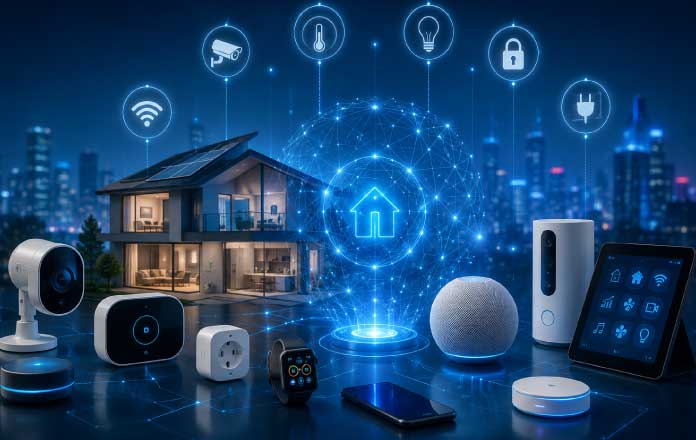
The Internet of Things (IoT) has come a long way since its inception, when it promised to connect all kinds of objects to the internet. However, over time, IoT devices have not only come to control smart homes, boost industrial operations, facilitate remote healthcare, and connect smart cities, but also enable a range of other applications. Still, they are soon going to become smarter, more autonomous, safer, and seamlessly integrated into everyday life.
Evolution with Intelligent Devices
Early versions of IoT were primarily focused on connectivity and data acquisition. The upcoming versions will focus more on intelligence. With a combination of Artificial Intelligence and Machine Learning, IoT devices will not only collect information but will also analyse it in real time and make decisions independently.
Smart sensors, for instance, will be able to forecast machine failure before it occurs, dynamically manage energy consumption, and offer a personalised experience without human interaction. Such a paradigm shifts from reactive to predictive and prescriptive systems will significantly improve efficiency in sectors such as manufacturing, healthcare, and logistics.
Edge Computing & Latency
One of the most important emergent trends in the future of IoT is edge computing. In standard IoT systems, devices were connected to cloud servers for processing. Although this worked well, it presented latency, bandwidth, and security issues.
Edge computing can overcome these challenges by processing information where it is generated, either on the device or on a nearby edge device. Such devices using edge technology will become indispensable in self-driving cars, surveillance cameras, and other industries, as they must operate in real time.
Expansion of 5G & Beyond
One of the major drivers of IoT technology adoption is the advent of 5G. With very low latency, higher bandwidth, and support for connecting millions of devices over a square kilometer, 5G technology will enable various IoT applications that were not possible before.
Future IoT systems will integrate 5G communications into applications such as remote surgery, efficient traffic management, augmented reality, and large-scale IoT applications across diverse areas. Research on 6G technology is being conducted not only to achieve even faster speeds but also to combine communication and sensing so perfectly that the IoT will be even more versatile.
Increased Emphasis on Security & Privacy
With the influx of IoT devices, security and privacy issues have become widespread. Most of these devices were not designed with security in mind, making them prone to attacks. The future of IoT will require a focus on ‘security by design’.


Emerging trends will come from hardware-based security modules, enhanced encryption standards, secure boot solutions, and constant device authentication. Regulatory and compliance matters will drive industries to focus on protecting data and maintaining consumer privacy. Reliable IoT environments will become a necessity in realms such as healthcare and finance.
Interoperability & Standards
One of the most prominent issues in the present IoT ecosystem is fragmentation. Devices from different companies support incompatible platforms, which hamper scalability and integration. Future trends include increased support for interconnectivity.
Open standards and communication protocols will enable different IoT devices to work in perfect sync with each other. Industry associations and standard-setting bodies will have a critical role in creating a more integrated IoT ecosystem.
Emerging Trends in Sustainable & Energy-Efficient IoT
Sustainability is an emerging factor in technology innovation, and IoT is not left out. Future IoT technology designs will focus on using less power, relying on renewable resources, and promoting sustainability.
Energy-harvesting technology, perhaps based on solar, thermal, or kinetic energy, will enable battery-free or very long-life IoT solutions, especially in remote and large-scale deployments. Secondly, IoT will aid sustainability by enabling more innovative resource management, waste reduction, and optimised energy use across real estate, agriculture, and transport.
Expansion in Healthcare & Wearables Sectors
The healthcare sector is expected to see one of the most rapid evolutions in terms of IoT innovation. Wearables, remote patient monitoring solutions, and smart healthcare devices will become far more advanced.
Future healthcare devices will continuously monitor patients’ vital signs and detect early signs of anomalies. Such an innovation will thus aid preventive healthcare programs and reduce hospitalisations, thereby improving patient outcomes.
Autonomy in Self-Managing IoT Systems
A significant trend under this is the emergence of self-configuring, self-healing, and self-optimising autonomous IoT systems. They will operate with minimal human intervention with AI and analytics capabilities.
In an industrial setting, autonomous IoT networks will dynamically control production lines, supply chains, and maintenance cycles. In a smart city, IoT systems will self-regulate traffic, energy, and safety systems without human intervention.
A Smarter, Connected Future. The future of IoT devices is not simply about increasing connections but about becoming more innovative, faster, and more responsible technology. With intelligence moving to the edge of networks, their capabilities and focus on security and sustainability, IoT is poised to become a building block for the digital economy. A combined push from businesses, decision-makers, and tech inventors will be needed to make the most of these trends. Those who lead in adopting secure, interoperable, and innovative IoT solutions will be well-positioned to flourish in an increasingly connected world. The future of IoT will not only be a time of innovation but will also have a tangible impact on our lives, work, and interactions with nature.