





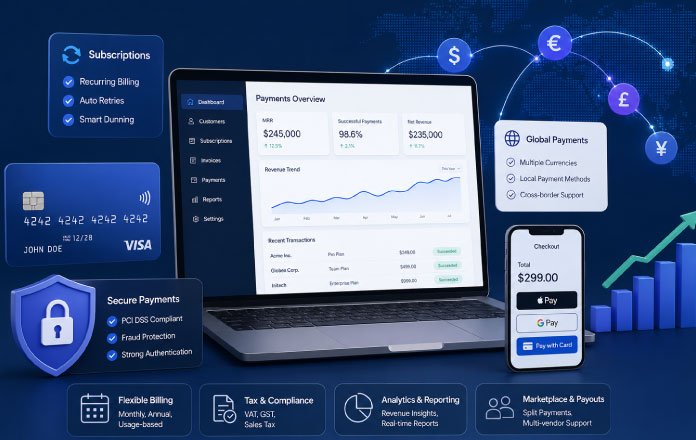
If you run a SaaS business, payment infrastructure isn’t just “the thing that accepts credit cards” — it shapes how customers experience your product, how reliably you collect revenue, and ultimately how fast you can grow. As more software companies sell into international markets and lean on subscription models, picking a payment platform stops being a quick technical decision and starts being a real strategic one.
The better SaaS payment tools on the market today handle recurring billing automatically, support a wide range of payment methods, deal with tax headaches, catch fraud before it costs you money, and push up transaction success rates. Some also let you embed payments directly into your product, which opens up a new revenue stream while giving you more control over the checkout experience.
Below, we walk through several of the leading providers, what each one does well, and the questions engineers, product managers, and other decision-makers should be asking before they commit to one.
Why Payment Infrastructure Actually Matters Here
Subscription businesses live and die on predictable cash flow. A payment that quietly fails to renew, or a checkout flow that’s clunky, can quietly chip away at retention and monthly recurring revenue — often before anyone notices.
SaaS companies tend to need things a typical online store doesn’t, including:
- Recurring subscription billing
- Usage-based pricing
- Automatic retries on failed payments
- Self-service account management for customers
- Support for international payments
- Tax calculation
- Revenue reporting
- Payouts for marketplaces or multi-vendor setups
As a company grows into new markets, these needs multiply fast. Getting the payment provider right early on saves you from a painful migration later — switching processors once you have thousands of active subscriptions is not fun.
What to Look for Before You Choose
Although each SaaS company’s needs are somewhat unique, there are repeatable requirements across companies.
Global reach: Supporting users across different countries means handling different currencies, different regional payment methods, and different local banking regulations. Payments can only be successful if customers recognize available methods. Evaluating available SaaS offer support for multiple currencies, regional payment methods, cross-border payment support, and compliance in applicable jurisdictions.



Flexible billing: As subscriptions form the core of the majority of the SaaS revenue, you should examine monthly vs. annual billing, pay-as-you-go versus tiered pricing, free trials, auto invoicing, ease of plan upgrades/downgrades, smart charge retries, and the like.
Developer experience: Team members will actually spend hours integrating this, so expect people to care about the quality of the documentation. Look at the REST APIs, webhook support, SDKs, sandbox/testing, the historical stability of the API versions, etc.
Security and compliance. This isn’t optional — you need PCI DSS compliance, tokenization, fraud detection, chargeback handling, identity verification, and strong customer authentication.
Pricing transparency. Fees vary a lot between providers, and the headline rate is rarely the whole story. Compare transaction fees, cross-border charges, currency conversion costs, monthly platform fees, billing-service charges, and any add-on fraud prevention fees. It’s easy to underestimate the real cost until you add it all up.
The Providers Worth Knowing
Stripe
Stripe is probably the name most developers think of first, and for good reason — its API ecosystem is huge and well documented. Businesses can build fairly custom payment flows and handle recurring billing through Stripe Billing.
Strengths: streamlined API docs, wide international acceptance, support for multiple currencies, subscription billing, marketplace payments via Stripe Connect, digital wallets, bank payments.
Good fit for: early stage companies, dev focused teams, global SaaS, subscription based businesses.
Good to know: Core pricing is straightforward. However, when you start to add fraud protection, billing automation, or advanced reporting, the combined cost is likely greater than the base cost, so do not assume the base cost is the total cost.
Finix
Finix takes a different approach — instead of positioning itself purely as a gateway, it’s built for SaaS companies that want to own more of their payment stack over time. You can embed payments into your product and gradually take on more of the payment operations yourself, or lean on their no-code options if you’d rather not build it from scratch.
Strengths: integrated payment systems, adaptable APIs, simplified merchant sign-up, automated compliance, risk management, and marketplace enabled.
What differentiates it: Finix is focused on companies who want to integrate payment systems as a core piece of their business and not as a means to check off an item on a list.
Adyen
Although several companies operate within the same sphere as Adyen, they would most likely call themselves competitors. Adyen aims its business at mid-to-large international companies. The three elements of payments – online, app and in-person – are unified in a single system. Interestingly, Adyen is more transparent with their pricing when compared to other payment companies. Pricing is done per transaction.
Strengths: global use, scalable for large enterprises, fast fraud detection, multi-channel, advanced reporting and risk analysis via ML.
Good fit for: enterprise SaaS, large-volume businesses, global marketplaces.
Worth knowing: smaller teams may find the setup heavier than lighter alternatives — it’s built for scale, not speed of implementation.
Paddle
Paddle works differently: it acts as the Merchant of Record, meaning it takes on tax collection, compliance, and a good chunk of the legal responsibility that comes with selling software internationally.
Strengths: VAT and GST handling, sales tax collection, international compliance, subscription billing, global payment support.
Why teams choose it: for startups expanding abroad, this can cut out a lot of administrative work that would otherwise fall on your finance team.
Worth knowing: because Paddle owns more of the transaction, businesses that want tight control over custom payment flows may find it a bit more rigid than a traditional processor.
Recurly
Recurly’s focus is narrower and deeper: subscription lifecycle management. Rather than competing head-on as a payment processor, it’s built to protect recurring revenue through smarter dunning and payment recovery.
Strengths: subscription automation, adaptable pricing models, smart dunning, retention strategies, revenue analytics, and integration with various payment gateways
Good fit for: subscription-based businesses, membership businesses, digital services, streaming services.
Worth knowing: Recurly doesn’t take on merchant or tax responsibilities the way Paddle does — that stays with you.
Quick Comparison
| Platform | Primary Strength | Best For |
| Stripe | Developer ecosystem, flexibility | Startups and global SaaS companies |
| Finix | Embedded payments, payment ownership | Platforms building their own payment infrastructure |
| Adyen | Enterprise-scale global payments | Large international businesses |
| Paddle | Merchant of Record services | SaaS companies selling globally |
| Recurly | Subscription lifecycle management | Subscription-first businesses |
couple of years — then match that against what each platform is actually built for.
Final Thoughts
Selecting a payment platform is an integral part of your business and affects the overall customer experience and the health of your business in the long run. There are many payment platforms out there, and each has its own unique advantages and disadvantages. The best payment platform is the one that aligns with your strategic business goals.
Traditionally, payment platforms have been selected based on transaction fees, but you should consider how platform features will affect your business long term, pay particular attention to the ease of integration, and flexible subscription options, etc. If you do these things, you’ll end up with a payment platform that you don’t have to put much thought into.