





A few years ago, payments were the part of a SaaS product nobody wanted to think about. You bolted on a checkout, pointed it at a processor, and moved on. That’s changed. Founders and product teams now treat payments the way they treat onboarding or support — as a piece of the customer experience that can either build trust or quietly chip away at it.
When you are selling software in all of Europe, the change becomes even more important since Europe does not act as a single market. Something that works really well in Germany may completely flop in the Netherlands because you don’t offer iDEAL as an option. A subscription service that goes through without any issue in the UK could have trouble complying with VAT regulations when it moves to other countries in the EU. And that’s the kind of scenario where a lot of SaaS firms have moved towards white label payment solutions.
Here’s what that actually means in practice, and what’s worth thinking through before you commit to one.
Why Bother With White Label Payments at All?
The honest answer is that customers rarely say “I love your checkout.” They notice it when it’s bad — when they get redirected somewhere unfamiliar, or the page looks nothing like the product they were using. A white label setup keeps the entire payment experience inside your own product, which sounds like a small thing until you look at the abandonment data most SaaS companies quietly track. Unfamiliar redirects are one of the more common reasons people drop off right before paying.
There’s also a business case beyond experience. Some SaaS companies have started treating payments as a genuine revenue line rather than a cost center — earning a cut on transaction volume, bundling in premium billing tools, or offering embedded financial features to customers in industries like healthcare or logistics, where that kind of convenience is worth paying for.
And there’s also the issue of the scale. Being able to sell in Europe requires having to handle different currency systems, varied payment preferences, and VAT requirements that change based on where your customer is from. It is definitely doable, but it is definitely not core functionality – it’s one more layer of infrastructure that takes months of engineering effort.
What to Actually Look for in a Provider
However, not all white label platforms are created equal, and the features that look attractive in the sales deck might not be the ones that really matter. Here are some points to test before you decide to work with a platform:
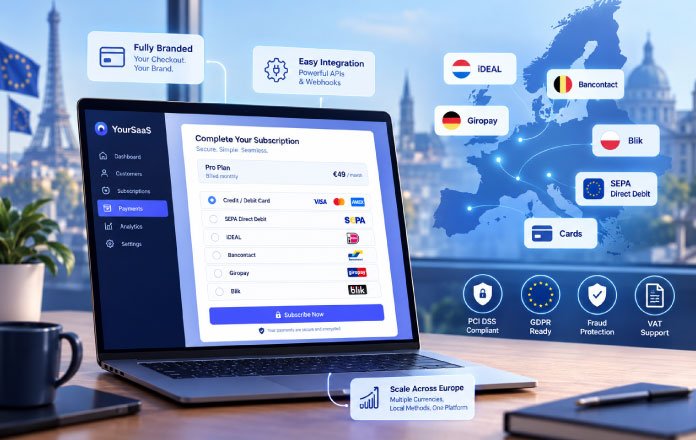
Is it possible for it to be yours? There are some solutions that will allow you to add your logo, and you believe that you have customized a solution. Other solutions give you more ability to customize your checkout by using your colors, fonts, and so forth, without having your engineers rebuild the checkout page every time.



Does it handle billing the way your business actually runs? Monthly plans, annual discounts, free trials, usage-based pricing, failed payment retries — most providers claim to support all of this, but the details matter. How does it handle a failed renewal? Does it retry automatically, and can you customize the dunning emails, or are you stuck with generic ones?
Does it support how Europeans actually pay? This is where a lot of platforms fall short outside their home market. Cards are common everywhere, but plenty of European customers default to something else — iDEAL in the Netherlands, Bancontact in Belgium, Giropay or SOFORT-style bank transfers in Germany, Blik in Poland, SEPA direct debit for recurring B2B payments across the Eurozone. A platform that only handles cards well is going to quietly cost you conversions in these markets.
Is this all just about compliance, or is it for real? PCI DSS compliance, tokenization, fraud screening, 3D Secure, GDPR-compliant handling of the data – these are not options to consider but rather basic requirements when working in Europe. What we really need to understand is who will be held responsible in case of a problem.
Can they develop with it at speed? The quality of the documentation is hugely variable. Make sure there is proper API documentation, code examples that work, webhooks, and a sandbox environment that can be tested against prior to going live.
Why “European Payments” Isn’t One Problem
It’s tempting to treat Europe as a single region with one set of rules, but that’s not how it works on the ground. A customer in Amsterdam and a customer in Warsaw have different default payment habits, different bank infrastructure, and different comfort levels with cards versus bank transfers. VAT treatment also isn’t uniform — what you owe and how you report it can shift depending on where the buyer is based, not just where your company is registered.
None of this is a reason to avoid expanding across Europe. The payment infrastructure there is genuinely more complex than in a single-currency, single-regulator market like the US. A good white label platform is one that’s already solved these regional quirks, so your team doesn’t have to relearn them market by market.
Where This Leaves You
In case you are reviewing service providers, the relevant activity for you would not be studying the list of features but rather matching your specific case to them. To which countries are you selling, and do they support the payment types that your clients will be looking for? How sophisticated is your billing system, and is your subscription management technology compatible with it, or will you have to develop your own solutions?
Payments are one of the few parts of a SaaS product where getting it right is invisible, but getting it wrong is instantly obvious to every customer who hits “pay” and hesitates. That’s usually reason enough to spend more time on this decision than it might initially seem to deserve.