





The market for SaaS solutions is changing rapidly, and payment processing has become more than just going through a check-out process. Modern clients demand an integrated subscription, various payment methods, immediate confirmation, and secure transactions that seem to be a natural part of your software. A poor payment experience is likely to result in failure to complete a transaction or switching to a competitor’s solution.
That’s why many software companies are exploring white label payment platforms — and, closely related, payment processors with strong branding and API customization. These two categories get used interchangeably online, but they solve different problems and picking the wrong one can cost you months of engineering time or an unexpected compliance burden. This guide draws that line clearly, then covers the leading options in each category for SaaS businesses operating in Europe.
White Label vs Branded Payment Processing: The Distinction That Matters
This is the single most important thing to understand before you start comparing vendors, so it’s worth being precise about it upfront.
A true white label payment platform lets you operate as if you were the payment provider yourself. Your business (or your customers, if you’re a platform reselling payments to sub-merchants) appears on statements, in dispute correspondence, and in the merchant-of-record relationship. This usually means becoming a Payment Facilitator (PayFac) or working with a PayFac-as-a-Service / Banking-as-a-Service (BaaS) provider that lets you sit underneath your own brand end-to-end, including onboarding and underwriting your users. Examples of providers built specifically for this model include Stripe Connect, Adyen for Platforms, Airwallex, Solaris, and Weavr.
A branded (or “brandable”) payment processor, by contrast, gives you a fully customizable checkout UI — your logo, your colors, your domain — but the processing entity, compliance obligations, and merchant relationship still sit with the provider. This is what most SaaS companies actually need if they’re simply collecting subscription payments from their own customers, rather than facilitating payments on behalf of other businesses. Stripe, Adyen, Checkout.com, Nuvei, and Worldpay fall into this category for the majority of their SaaS customers — excellent for a branded checkout experience, but not “white label” in the strict sense unless you specifically integrate their platform/marketplace products.
If your SaaS product is a marketplace or vertical platform where your own customers need to accept payments from their customers (think: a booking platform, a freelancer marketplace, or a vertical SaaS tool for salons or clinics), you need the first category. If you’re simply billing your own subscribers, the second category is usually simpler, faster to implement, and cheaper.
Why SaaS Companies Are Investing in Modern Payment Infrastructure
Payment experiences directly influence customer satisfaction. Even an excellent software product can lose customers if the payment process creates unnecessary friction.
Stronger brand experience. Keeping customers inside your platform throughout the payment process creates a more professional experience and builds trust.



Better customer retention. A streamlined process reduces failed transactions and abandoned purchases. Saved payment methods, automatic renewals, and localized payment options all help customers stay subscribed.
Additional revenue streams. Platforms operating a true PayFac model can earn a share of transaction volume from their sub-merchants — a meaningful revenue line that sits on top of subscription income.
International growth is quicker. Expansion into Europe means that you need to accommodate various currencies, payment preferences in different regions, and regulations like VAT/OSS reporting, PSD2/SCA, etc. Having the proper infrastructure means that you can expand without changing your payment system each time you enter a new market.
Essential Features to Look For
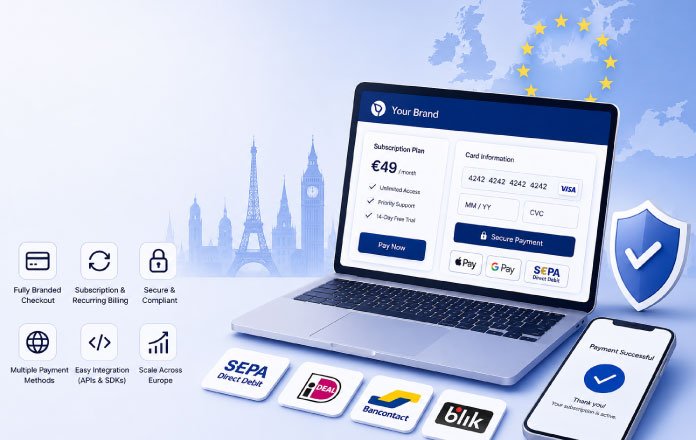
Fully branded checkout — complete customization of payment pages, logos, colors, fonts, and customer communications.
Subscription management, including:
- Monthly and annual plans
- Usage-based billing
- Free trials
- Automatic renewals
- Failed payment / dunning recovery
Multiple payment methods. European customers expect flexibility — Visa, Mastercard, American Express, Apple Pay, Google Pay, SEPA Direct Debit, and popular local methods (iDEAL in the Netherlands, Bancontact in Belgium, Blik in Poland, and others depending on your target markets).
Security and compliance, including PCI DSS compliance, tokenization, fraud monitoring, 3D Secure / Strong Customer Authentication (SCA) under PSD2, and GDPR-compliant data handling.
Easy integration — developer-friendly APIs, SDKs, webhooks, and clear documentation to reduce implementation time and ongoing maintenance.
Leading Payment Platforms for SaaS in Europe (2026)
- Stripe
Best for: SaaS companies that require scalable payments solutions and quick and thorough integration. Stripe continues to be the default choice for developers due to its API-focused development process and established suite of billing capabilities (Stripe Billing). Businesses looking to run a marketplace or platform business can leverage Stripe’s connect solution that delivers a true PayFac / white-label experience.
- Pros: excellent documentation, fast implementation, large integration ecosystem, scales from startup to marketplace use cases via Connect.
- Cons: advanced Connect features add implementation complexity; effective costs rise with volume and add-ons.
- Adyen
Most suitable for: Large scale SaaS business dealing with significant numbers of transactions in multiple European countries. Adyen provides a seamless solution with excellent local payment methods support. Adyen for Platforms is the special product by Adyen for business that require sub-merchant onboarding and white labeling of payments.
- Pros: strong pan-European coverage, high reliability, advanced reporting.
- Cons: onboarding is more involved than some competitors; better suited to medium and large businesses than early-stage startups.
- Checkout.com
Best for: Fast-growing SaaS businesses processing high payment volumes that need smart routing and strong authorization rates.
- Pros: competitive payment performance, strong international coverage, modern developer experience.
- Cons: pricing and support model are generally geared toward scale-ups and enterprises rather than very early-stage startups.
- Nuvei
Best for: SaaS platforms expanding into many international markets that need broad local payment method coverage.
- Pros: very wide payment method support, recurring billing, marketplace-style payment capabilities.
- Cons: some advanced features require additional configuration and account-level setup.
- Worldpay
Best for: Established SaaS businesses that prioritize stability and compliance credentials over cutting-edge developer tooling.
- Pros: reliable infrastructure, strong compliance track record, suited to enterprise procurement processes.
- Cons: developer experience and dashboard feel dated next to newer competitors.
- Airwallex
Best for: SaaS platforms that need embedded finance and true white-label capability, including issuing accounts or cards to their own users. Airwallex is built explicitly for embedding financial products — including payments, FX, and card issuing — under a platform’s own brand, making it a closer fit to the strict definition of “white label” than a standard branded checkout.
- Pros: strong embedded finance / BaaS toolkit, competitive FX, multi-currency accounts.
- Cons: smaller ecosystem and community than Stripe or Adyen; feature depth varies by country.
Comparison Table
| Platform | Best For | True White-Label / PayFac Option | Subscription Billing | Multi-Currency | API Quality |
| Stripe | Startups & growth | Yes (Stripe Connect) | Yes | Yes | Excellent |
| Adyen | Enterprise | Yes (Adyen for Platforms) | Yes | Yes | Excellent |
| Checkout.com | Scaling SaaS | Limited | Yes | Yes | Excellent |
| Nuvei | International expansion | Yes | Yes | Yes | Very Good |
| Worldpay | Large businesses | Limited | Yes | Yes | Good |
| Airwallex | Embedded finance / BaaS | Yes | Yes | Yes | Very Good |
How to Choose the Right Platform
- If you’re simply billing your own SaaS subscribers, prioritize ease of integration, transparent pricing, and strong subscription/dunning tooling — Stripe, Checkout.com, or Adyen’s standard offering are usually sufficient.
- If you’re building a marketplace or platform that pays out to other businesses, you need genuine PayFac/white-label capability — evaluate Stripe Connect, Adyen for Platforms, or Airwallex specifically, and budget time for underwriting and KYC/KYB requirements.
- Enterprise organizations should weight compliance certifications, uptime SLAs, dedicated support, and reporting depth heavily in the decision.
Before signing up, assess the quality of the API documentation, time taken to settle transactions, disputes handling process, local payment systems available for the market you are targeting, and most importantly if the pricing structure of the merchant is compatible with your transaction pattern.
Final Thoughts
Payments have become a core aspect of the SaaS user experience, rather than an auxiliary one. “White label payments” and “branded payment processing” both represent a solution for different issues, and your choice will depend on whether you need to make your customers receive payments using your software product. Only after understanding this, evaluate various service providers based on your compliance requirements, market, and stage of development.
FAQs
- What is a true white label payment platform? It’s payment infrastructure — typically a PayFac-as-a-Service or Banking-as-a-Service product — that lets a business operate as the merchant of record and onboard its own sub-merchants under its own brand, with the underlying provider invisible to end customers.
- Is Stripe a white-label payment service provider? While Stripe’s normal service offers customization and branding, it isn’t really a white-label service. However, Stripe Connect, which is Stripe’s platform product, does offer white-label capabilities.
- Do I need a white-label or PayFac model for a regular SaaS product with subscription plans? Generally not. In case you bill your own clients, a branded payment processing service with excellent subscription billing (such as the classic version of Stripe or Adyen) is often easier, quicker to set up, and cheaper than being a PayFac.
- What are the key factors to consider when comparing the providers? Billing solutions, API capabilities, security (PCI DSS, SCA/3D secure), multiple currency and local payment method support, as well as sub-merchant integration, in case you are building a platform.
- Do these platforms conform to the standards of European regulations? The main players have features of PCI DSS compliance, GDPR data processing, and PSD2/SCA requirements. Nevertheless, depending on the specific model of the business (merchant of record or payment facilitator), the particularities of the regulatory compliance may vary.