





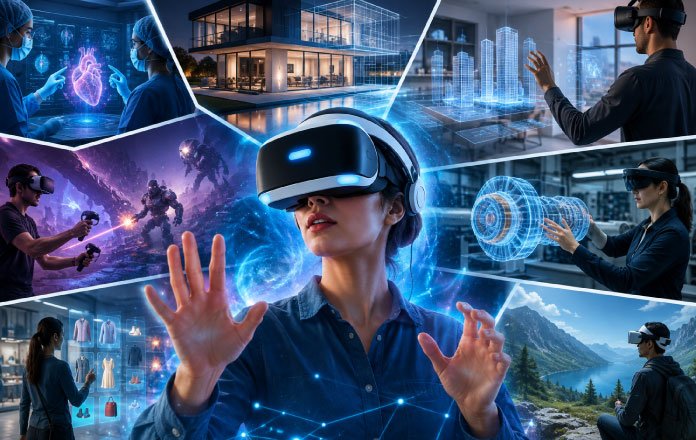
Virtual reality (VR) is no longer limited to gaming or entertainment. Over the years, the technology has found practical applications across education, healthcare, construction, e-commerce, engineering, real estate, marketing and several other sectors.
When people think about VR, names such as Apple, Google, Meta and Microsoft may come to mind. However, a wider group of technology companies is also building products, platforms and experiences around VR and related technologies.
From immersive entertainment to medical robotics, these companies are showing how virtual experiences can be applied to real-world business and consumer needs. Here are 10 VR companies worth knowing about in 2026.
What Is Virtual Reality?
Virtual reality is a computer-generated environment that creates an alternative world for the user. Depending on the application, people can access VR through a computer, smartphone application or a headset with an integrated processor.
Some experiences also use wearable equipment fitted with sensors. These can include gloves, vests and suits that allow the system to track movement and make the virtual environment more interactive.
A good VR experience is not simply about putting on a headset. Developers need to consider several important elements:
- Believability: The virtual environment should feel realistic.
- Comfort: Users should be able to use the experience comfortably.
- Immersion: The experience should make users feel involved in the virtual environment.
- Intuitiveness: Interactions should feel natural and easy to understand.
- User control: People should feel that they can control what happens around them.
- User safety: The experience should provide a sense of physical and digital safety.
Which Industries Are Using VR?
VR was once strongly connected with video games and social media. That picture has changed considerably.
Today, businesses and organisations are exploring VR across several industries, including:



- Construction
- E-commerce
- Education
- Engineering
- Furniture design
- Entertainment
- Health care
- Marketing
- Real estate
- Wellness
The reason is straightforward: VR can allow people to visualise, practise, or experience situations without being physically present in the actual environment.
10 VR Companies to Know in 2026
1. CitrusBits
CitrusBits is based in Pleasanton, California, and provides services covering product design, software development, mobile applications and technical support.
The company also has experience in augmented reality (AR) and VR development. Its work spans multiple industries, helping clients use immersive technologies to address their technology requirements.
2. Groove Jones
Groove Jones is a Texas-based company specialising in extended reality (XR). XR is a broader category that includes augmented reality, virtual reality and mixed reality.
The company uses its proprietary GrooveTech™ technology for a range of client projects. Its services include:
- Animation and computer-generated imagery (CGI)
- Audience engagement installations
- Camera lenses and social media filters
- Consulting and support
- Immersive videos
- Interactive web applications
- Mobile applications
- Website development and WebGL
3. Magic Leap
Magic Leap develops software and human-computer interfaces and is based in Plantation, Florida.
Its Magic Leap 2 AR headset is designed for business users. The device combines a user’s physical surroundings with digital information, creating an environment where remote teams can collaborate.
For businesses, this can help reduce travel requirements, improve workflows and support workforce productivity while potentially delivering better returns on investment.
4. Matterport
Matterport, headquartered in Sunnyvale, California, focuses on spatial data.
The company creates digital 3D representations of physical locations such as homes, offices, shops, hotels and factories. Its technology serves industries including manufacturing, real estate and travel.
Its spatial computing platform can be used in areas such as building design, construction, repair and marketing.
5. Scopely Explore (formerly Niantic)
Scopely acquired Niantic in 2025, and the business now operates as Scopely Explore.
The company develops AR applications and games designed to encourage people to connect with others and explore outdoor environments.
Niantic was also involved in the technology that became Google Earth and Google Maps. Its work included Lightship, a platform that enables developers to create AR experiences or add AR capabilities to existing products.
Its portfolio has also included popular titles such as Peridot and Pokémon GO.
6. Sandbox VR
Sandbox VR, headquartered in San Francisco, develops immersive VR experiences for groups of up to six players.
Its locations operate across the US, Europe and Asia. Players can select different storylines and enter virtual environments where they can interact with one another.
The company combines technologies such as motion-capture cameras, haptic suits and 3D body trackers to create a more realistic experience.
7. Shockoe
Shockoe is a Virginia-based company that focuses on mobile application development.
Its approach centres on creating applications customised around client requirements. The company helps businesses work towards goals such as improving customer and brand loyalty, increasing engagement and supporting business growth.
Shockoe also works on applications designed for wearable devices, including smartwatches and headsets.
8. Snap Inc.
Snap Inc., based in Santa Monica, California, is widely known for Snapchat, its camera-focused social media platform.
The company’s work also extends into augmented reality. Snap AR and Lens Studio allow creators to develop and share AR experiences through Snapchat.
The company also develops Spectacles, which provide AR-based sharing and interactive experiences.
9. Unity
Unity is a San Francisco-based software company known for tools used to create and interact with 2D, 3D, AR and VR content.
Its technology is used by professionals across a wide range of fields, including architecture, automotive design, engineering, filmmaking, construction, art and video game development.
Unity offers subscription options for new users and students, along with paid plans based on different creative requirements.
10. Vicarious Surgical
Vicarious Surgical, based in Waltham, Massachusetts, specialises in medical robotics.
Its robotic system uses a 3D high-definition camera to give surgeons visibility while providing greater precision and control over surgical instruments.
The company aims to make surgery more efficient while potentially reducing healthcare costs. Its minimally invasive approach can also contribute to fewer complications, shorter recovery periods and better patient outcomes.
Which Companies Are Using VR?
Well-known companies are also adopting VR to create more interactive customer and media experiences.
American Express developed an interactive VR experience around its sponsorship of the US Open. The experience allowed users to compete virtually against professional tennis player Maria Sharapova.
IKEA worked with Apple on a VR application that allowed customers to virtually place IKEA furniture inside their homes. This gave customers a way to see how products might look before making a purchase.
The New York Times also worked with a technology company on a VR application designed to add an immersive element to its journalism. One example allowed readers to experience life inside a refugee camp from the perspective of a child living there.
Why VR Companies Matter
The VR industry is becoming broader as companies look beyond entertainment and explore practical applications.
The companies covered here represent different parts of the ecosystem. Some develop software and applications, while others focus on AR experiences, immersive entertainment, spatial data, wearable technology or medical robotics.
For businesses, this wider ecosystem means VR can be considered for more than gaming. It can support customer engagement, product visualisation, remote collaboration, training, design and specialised professional applications.
For people looking to build a career in the field, understanding how these technologies are being used across industries can also provide a useful starting point for developing relevant skills.
Learn More About Virtual Reality
People interested in VR can begin by learning the fundamentals of the technology and then exploring practical applications such as computer graphics, animation, game development and Unity.
The field covers much more than wearing a headset and entering a virtual environment. It brings together software, hardware, design and user interaction to create experiences that can be used across consumer and professional settings.
As more industries experiment with immersive technology, understanding the companies and platforms shaping VR can help beginners get a clearer picture of where the industry is heading.