





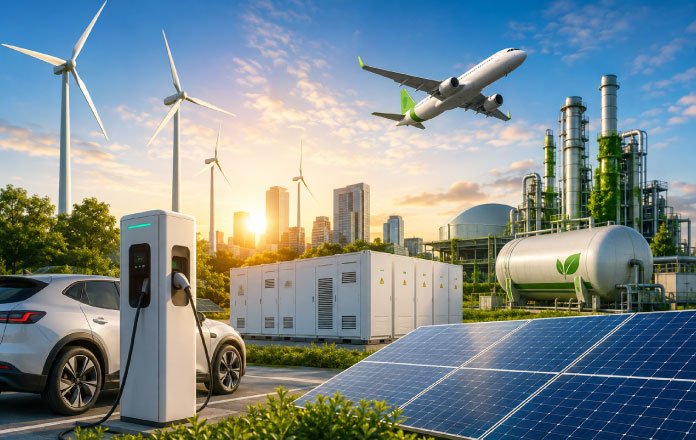
India and other major markets are investing heavily in clean energy. But the sector is no longer about developing solar panels, batteries or electric vehicles alone. The bigger task is building the infrastructure and manufacturing capacity required to put these technologies to work.
Recent developments in EV charging, sustainable aviation fuel, solar manufacturing and energy-storage technology show how companies are trying to solve different parts of this problem.
At the same time, one issue continues to come up: money. Large clean-energy projects need significant investment, and a shortage of suitable financing could slow their expansion.
Trinity Cleantech Takes EV Charging Beyond the Grid
Trinity Cleantech recently showcased its energy and electrical infrastructure solutions at the India Energy Summit & Expo 2026 in Hyderabad.
One of the main products on display was the ME Energy Rapid Charger 150, a 150 kW DC fast charger that uses bioethanol to generate electricity. The system is designed to work without a conventional grid connection. It has two CCS2 charging outputs and combines power generation, energy storage and EV charging in one system.
This could be useful in places where getting a new grid connection is difficult or takes considerable time.
Possible locations include:
- Highways and fleet depots
- Mining and industrial sites
- Rural areas
- Defence and strategic locations
- Construction sites
- Emergency backup facilities
Trinity also showcased packaged and compact substations in the 250 kVA to 2500 kVA range and up to 33 kV. These systems bring transformers, switchgear, protection, metering and other electrical equipment together in a compact unit.


The company is positioning these products as part of a wider effort to make EV and power infrastructure easier to deploy.
Aviation Looks for New Sources of Sustainable Fuel
The aviation industry has another problem to solve. Sustainable aviation fuel, or SAF, is expected to play an important role in reducing emissions from flying, but the availability of suitable raw materials remains a concern.
Nova Pangaea Technologies is working on one possible alternative. The UK company is developing a process that converts waste biomass such as wood residues and wheat straw into ethanol.
The ethanol can then be used to produce sustainable aviation fuel and renewable diesel.
The company recently completed endurance trials at its demonstration plant on Teesside. The trials ran for periods of up to 72 hours and achieved yields above the company’s target.
The process also produces biochar, which can store carbon for a long period.
Nova Pangaea is working with British Airways and LanzaJet through Project Speedbird. The UK government supports the project and focuses on producing aviation fuel from waste biomass.
The company has plans for four UK facilities that would produce bioethanol from locally available waste material.
Insolation Energy Builds More of the Solar Supply Chain
India is also looking to strengthen its domestic solar manufacturing base.
Insolation Energy currently has 5.5 GW of solar module manufacturing capacity at its facilities in Jaipur. The company is also planning a 4.5 GW solar cell manufacturing facility in Madhya Pradesh.
Its longer-term plans include backward integration into ingot and wafer manufacturing. The company has said it wants to develop a 4.5 GW captive ingot and wafer ecosystem.
The move is important because India is trying to reduce its dependence on imported solar components.
Insolation Energy reported consolidated revenue of ₹740.7 crore for Q1 FY27, a 104.68% increase from the previous year. However, net profit fell 11.81% to ₹38.02 crore.
The company also received a ₹558.29 crore solar PV module supply contract from NTPC Renewable Energy. Its order book crossed 2.1 GW.
The expansion gives the company greater control over its supply chain, but it also means higher capital requirements and execution risks.
Battery and Solar Systems Need Better Management
Another area receiving attention is the way existing clean-energy equipment is managed.
REON Technology, based in Chelmsford, Massachusetts, has received a $100,000 award through a Massachusetts Clean Energy Center programme.
The funding will support the company’s work to improve the management and performance of battery and solar energy systems and help extend their useful operating life.
MassCEC included REON among 18 climate tech companies receiving a combined $27.2 million in state incentives. The programme covers several areas, including energy storage, clean transportation, hydrogen, advanced manufacturing and sustainable aviation fuel.
For battery and solar projects, improving how equipment is operated can be as important as installing new equipment. Better management can help companies get more useful years from expensive assets.
Financing Could Become the Bigger Problem
Technology is moving forward, but clean-energy projects still need funding.
Global energy investment is expected to reach a record $3.3 trillion in 2025, with around $2.2 trillion going toward clean-energy technologies. However, the investment required for supporting infrastructure remains substantial.
Grids, storage facilities, charging networks and other energy infrastructure require large amounts of capital. These projects can also take years to develop and often involve complicated financial structures.
That creates a gap between the money available and the amount needed to build the infrastructure required for the energy transition.
For investors and lenders, projects involving new technologies can also be harder to assess. Developers may therefore face higher financing costs or longer timelines before projects reach completion.
The Real Test Is Scaling Up
The recent developments show that clean-energy companies are tackling different parts of the same larger problem.
Trinity Cleantech is looking at EV charging where grid access is limited. Nova Pangaea is working on converting waste biomass into fuel for aviation. Insolation Energy is expanding its solar manufacturing chain. REON Technology is working on better management of battery and solar systems.
These technologies are important, but developing them is only one part of the job.
The bigger question is how quickly they can be manufactured, financed and deployed commercially.
For India and other markets, the next stage of the clean-energy transition will depend on more than technology. Reliable infrastructure, domestic supply chains and access to capital will all have to grow alongside demand.
That is where the industry faces its biggest test—and where the companies solving these practical problems could find their strongest opportunities.