





A doctor finishes seeing a patient, but the work is not over. The consultation notes still need to be completed. Test reports have to be checked, the next appointment must be arranged, and the billing team may need additional information to process an insurance claim. Multiply these tasks by dozens or hundreds of patients, and the amount of administrative work becomes clear.
This is a familiar situation in many hospitals and clinics. Healthcare professionals have to manage patient care alongside records, appointments, reports and other routine responsibilities. When these tasks depend entirely on manual work, delays and mistakes become harder to avoid.
Healthcare automation is one way to address this problem. With the help of artificial intelligence (AI), certain tasks can be handled with less manual effort. However, the real question is not how much technology a hospital can introduce. It is whether that technology makes daily work easier without affecting patient care.
What Does AI Automation Mean for Healthcare?
Automation is not new to hospitals. Appointment reminders, online registration and automatic billing checks have been around for some time. AI adds another layer by allowing software to work with information such as written messages, spoken conversations and medical records.
Take medical documentation as an example. A doctor usually needs to record the patient’s symptoms, observations and treatment plan after a consultation. An AI tool can listen to the conversation, prepare a draft of the notes and organise the information into a suitable format. The doctor can then check the draft and make corrections.
The same principle applies to other hospital activities. Software can help staff organise patient enquiries, identify missing details in billing documents and keep track of routine follow-ups.
There is a limit, though. A tool may prepare a medical note, but it cannot take responsibility for whether that note accurately reflects the consultation. That responsibility remains with the healthcare professional.
Where Can Hospitals Use AI Automation?
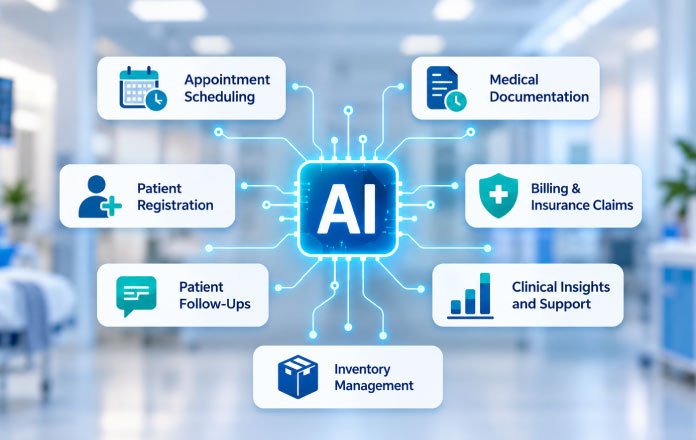
1. Patient Registration and Appointment Management
The registration desk is often busy before the doctor has even started seeing patients. Staff must collect personal details, check medical histories, record insurance information and ensure that the required forms are complete.



Online registration allows patients to submit much of this information before arriving at the hospital. Automated checks can flag missing details, while scheduling software can help manage available appointment slots.
Appointment reminders are another useful application. Patients can receive messages before their scheduled visits, and chatbots can answer basic questions about appointments and registration.
These tools will not eliminate waiting times altogether. Emergency cases, late arrivals and delays in consultations can still affect the schedule. They can, however, reduce some of the avoidable work at the front desk.
2. Medical Notes and Documentation
Doctors need accurate records for every patient they treat. Yet completing documentation takes time, particularly when a busy consultation schedule leaves little room between appointments.
AI-based transcription tools can convert spoken conversations into text and prepare draft clinical notes. They can also help organise information from patient histories, medication lists and referral documents.
The doctor must review the result before it becomes part of the patient’s record. Medical terminology can be misinterpreted, and an important detail may be missed during transcription.
Used carefully, these tools can reduce the amount of typing involved in documentation. They are especially useful when they fit into the hospital’s existing record-keeping process instead of creating another system for staff to manage.
3. Billing and Insurance Claims
Insurance claims often require information from different parts of a patient’s record. If a document is incomplete or a medical code is incorrect, the claim may be delayed or rejected. Staff then have to identify the problem and submit the necessary corrections.
Automation can help check billing documents before submission. AI tools may also suggest medical codes based on clinical notes, which qualified staff can verify.
The benefit is straightforward: errors can be identified earlier, reducing the need to revisit the same claim several times. The system still needs to follow the applicable billing rules, and staff must check information that could affect the final claim.
4. Patient Follow-Ups and Communication
A patient’s visit may be over, but further action may still be required. The hospital might need to arrange another appointment, send a reminder or direct a question to the right department.
Automated systems can handle routine notifications and organise incoming messages. For instance, a request to change an appointment can go to the administrative team, while a message raising a medical concern can be sent for review by the appropriate healthcare professional.
This distinction matters. A chatbot can respond to routine enquiries, but it should not treat a potentially serious medical complaint as an ordinary administrative request.
5. Medical Reports and Clinical Support
Doctors and radiologists regularly work with medical histories, test results and imaging reports. AI tools can examine available information and flag patterns or findings that deserve closer attention.
In medical imaging, certain systems can highlight potentially significant findings for a radiologist to review. Other tools can help identify patterns in patient data that may indicate a need for further assessment.
These findings are additional inputs, not a final diagnosis. Doctors must consider the patient’s symptoms, examination results and medical history before deciding what action to take.
6. Hospital Supplies and Resource Planning
A shortage of essential medicines or equipment can disrupt hospital operations. On the other hand, ordering more supplies than necessary can lead to waste, including products that expire before use.
Inventory software can track stock levels and alert staff when supplies run low. AI-based forecasting tools can also examine past usage to estimate future requirements.
Hospital administrators can use operational information to plan staffing, equipment and service capacity. Such estimates need regular review because patient demand can change unexpectedly.
What Difference Can Automation Make?
The results depend on the system and the way a hospital uses it. When implemented properly, automation can reduce repetitive data entry, help staff find missing information and make routine communication easier to manage.
Doctors may spend less time preparing notes. Billing teams may identify incomplete claims before submission. Reception staff may have fewer routine enquiries to handle manually.
Patients can also benefit when appointments are managed properly and follow-up messages reach them on time.
However, buying software does not automatically produce these results. A poorly chosen tool may create additional checks, duplicate records or another process that employees have to learn. Hospitals need to assess whether a system solves an existing problem before introducing it.
The Problems Hospitals Need to Address
Patient information requires careful handling. Healthcare providers must protect medical records, restrict access to authorised users and comply with the privacy and security requirements that apply to them.
Integration is another concern. A hospital may already use separate systems for appointments, laboratory reports, medical records and billing. If these applications cannot exchange information properly, staff may end up entering the same details more than once.
Employees also need time to learn the new process. Doctors, nurses and administrative teams should understand what the software can do, where it may make mistakes and when a person needs to review the result.
Most importantly, hospitals must not assume that every output from an AI system is correct. Medical notes, billing suggestions and clinical alerts need suitable checks. The level of oversight should reflect the risks involved.
What Comes Next?
Healthcare automation is likely to become more useful as hospital systems become better connected. A test result, for example, could trigger a notification or create a follow-up task for the relevant team. Connected applications could also reduce repeated data entry across departments.
Predictive tools may help hospitals estimate demand and plan resources, while clinical support systems may bring relevant findings to a doctor’s attention.
But technology alone will not resolve every operational problem. Hospitals still need reliable information, sensible procedures and staff who understand how the systems work.
Conclusion
Administrative work is part of running a hospital, but too much of it can take valuable time away from patients. AI automation offers a practical way to handle selected tasks, from preparing medical notes to checking claims and managing routine follow-ups.
The sensible approach is to begin with a clear problem, choose a tool that fits the existing workflow and check whether it delivers the expected results. Patient information must remain protected and healthcare professionals must continue to review information that affects clinical decisions.
Ultimately, automation should make the work of doctors, nurses and hospital staff more manageable. If it adds complexity instead of removing it, the technology is not doing its job.