





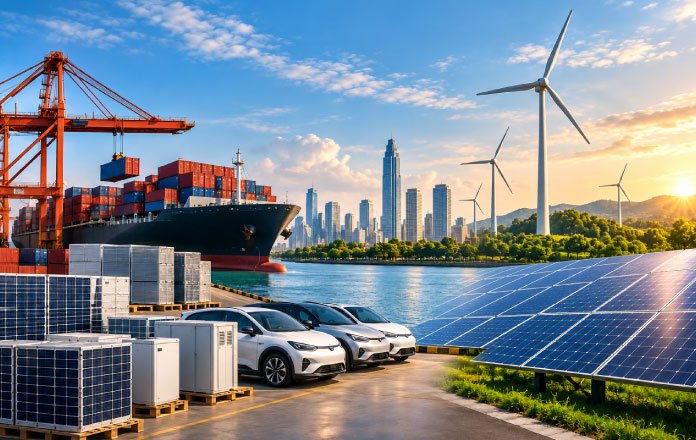
Southeast Asia is becoming an increasingly important market for China’s clean-energy products, as countries across the region invest more in solar power, batteries, electric vehicles and electricity networks.
The shift is significant for China’s clean-tech industry. European and North American markets have become more challenging because of rising trade tensions and efforts to strengthen domestic manufacturing. Southeast Asia, meanwhile, is showing strong demand for the equipment China produces on a large scale.
According to energy think tank Ember, countries belonging to the Association of Southeast Asian Nations (ASEAN) spent more than $20 billion on Chinese-made clean-tech products during 2026. This was around 50% higher than the same period a year earlier.
That spending has made Southeast Asia China’s largest clean-tech market within Asia.
Demand Is Growing Across Several Clean-Tech Areas
The demand is not limited to one type of product.
ASEAN countries are buying Chinese-made:
- Solar panels and related equipment
- Energy-storage batteries
- Electric vehicles
- Electricity-grid components
- Heating and cooling equipment
- Other clean-power technology
This wide range of demand is important for Chinese manufacturers. Instead of depending heavily on a single market or product category, companies can supply equipment to several parts of Southeast Asia’s growing energy system.
The region is going through rapid urbanisation and industrial development. Electricity consumption is also increasing as economies expand and digital activity grows.



At the same time, governments are adding renewable-energy capacity, upgrading power grids, promoting electric vehicles and encouraging local manufacturing.
All of these activities require equipment that Chinese manufacturers already produce at considerable scale.
Solar Imports Show the Change Clearly
Solar power is one of the strongest examples of this growing trade.
ASEAN countries spent around $4.1 billion on Chinese-made solar panels during 2026, according to the Reuters report. That was almost 90% higher than the comparable period in 2025.
ASEAN accounted for about 57% of China’s solar exports to Asia.
The Philippines, Malaysia, Indonesia and Vietnam were among the important buyers. Each of these countries roughly doubled its spending on Chinese solar imports compared with the previous year.
The numbers show how quickly the regional market is developing.
Solar is also only one part of the picture. Southeast Asian countries spent just under $7 billion on energy-storage batteries and around $1.6 billion on grid components.
The region also imported approximately $1.2 billion worth of heating and cooling systems and $6.3 billion worth of electric vehicles.
Southeast Asia’s Energy Needs Are Rising
The growth in clean-tech imports is closely connected with the region’s economic expansion.
ASEAN has a population of roughly 700 million people, while its annual GDP growth is around 5%, according to the Reuters report.
More economic activity means greater demand for electricity. Factories, cities, transport networks and digital infrastructure all need reliable power.
Coal still accounts for a majority of the region’s electricity generation. This creates a difficult challenge for governments: they need to meet rising electricity demand while gradually moving towards lower-carbon energy sources.
Solar panels, batteries, electric vehicles and modern grid equipment can support that transition.
This is why Southeast Asia’s importance goes beyond its role as a buyer of Chinese products. The equipment being imported is also helping countries build new energy infrastructure.
Spain Takes a Different Approach
While Southeast Asian countries are increasing their purchases of clean-tech equipment, Spain is taking steps to strengthen clean-tech manufacturing at home.
Spain has announced plans for a new aid programme aimed at supporting the manufacturing of clean-energy and net-zero technology.
The programme covers sectors including solar power, onshore wind, offshore wind and energy storage. Renewables Now lists the initiative under Spain’s clean-tech manufacturing and regulatory developments.
The move reflects a wider European effort to develop stronger domestic clean-tech supply chains.
For European countries, building manufacturing capacity at home can reduce dependence on imported equipment while also supporting local industrial activity.
Spain’s approach therefore differs from Southeast Asia’s current position. Southeast Asian economies are seeing strong growth in clean-tech deployment and imports, while Spain is focusing more directly on increasing domestic manufacturing capacity.
Two Important Trends in Clean Energy
The developments in Southeast Asia and Spain point to two different but connected trends in the global clean-energy industry.
The first is the rapid growth of demand in emerging markets.
Southeast Asia needs more electricity as its population, industries and economies expand. That is creating a large market for solar equipment, batteries, electric vehicles and grid technology.
The second trend is the push for local manufacturing.
Spain’s proposed support programme shows how European countries are trying to strengthen their own clean-tech production capabilities.
For China, Southeast Asia provides an important outlet for its large clean-tech manufacturing base. For Spain and other European countries, supporting local production could help build stronger supply chains and reduce dependence on external suppliers.
The Clean-Tech Market Is Changing
The clean-energy industry is no longer simply a story about which country manufactures the most equipment.
The location where products are used is becoming equally important.
Southeast Asia’s growing demand is giving Chinese clean-tech manufacturers a major market close to home, while Spain is working to strengthen its own manufacturing capabilities.
The figures also show that the clean-energy transition is spreading across several technologies at the same time.
Solar power, batteries, electric vehicles and grid equipment are all seeing increased demand.
As Southeast Asia continues to grow and Europe works to build domestic manufacturing, the global clean-tech supply chain is likely to become increasingly important to both energy policy and industrial strategy.