





A few years back, a cousin of mine who works in IT called me up one evening, pretty excited, saying he’d doubled his money in Reliance futures in about ten days. I asked him if he knew what a futures contract actually was. He didn’t. He’d seen it on a Telegram channel and just followed along. Six weeks later, most of that “doubled money” was gone, along with a fair bit of his original capital too.
I bring this up because it’s a fairly common story in India right now. Demat accounts have crossed 15 crore, discount broking apps have made opening an account a five-minute job on your phone, and a good chunk of new traders are coming in from tier-2 and tier-3 towns, not just the usual metro crowd. That’s genuinely a good thing for financial inclusion. But easy access to the market and actually knowing how to survive in it are two very different matters, and a lot of people confuse the former for the latter.
This piece is meant for someone starting from zero. Nothing fancy, no jargon for the sake of sounding smart, just what I’d tell a friend or family member before they put their first rupee into a trading account.
Trading Is Not the Same Thing as Investing
People use these words interchangeably all the time, and it causes more confusion than it should.
Investing is when you buy something like a stock or a mutual fund and you’re okay holding it for years. You’re betting on the company or the economy doing well over the long run, and you let compounding sort out the rest. Trading is different. You’re in and out much faster, sometimes within minutes, sometimes over a few weeks, and you’re trying to profit from the price movement itself rather than the underlying business.
If your money is earmarked for something five or ten years away, a retirement fund, your kid’s education, whatever, that money has no business being in an intraday trading account. That’s investing money. Trading is a separate skill you build with money you can genuinely afford to lose while you’re still learning.
Getting the Paperwork Sorted
You need three things before you can place your first trade.
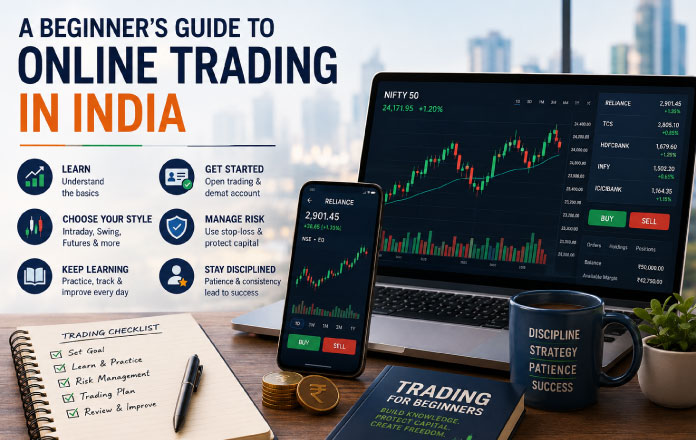
First, a trading account with a SEBI-registered broker. Zerodha, Groww, Upstox, Angel One, ICICI Direct, there’s no shortage of options. Don’t just pick whichever one your friend uses; actually compare brokerage charges, how often the app crashes during market hours (this matters more than people realise), and what their customer support is like when something goes wrong.



Second, a demat account, which is basically where your shares sit electronically once you own them. Most brokers bundle this in with the trading account these days, so you’re not filling out two separate sets of forms.
Third, a bank account linked to the trading account for moving money in and out.
The KYC process is entirely online now. Aadhaar, PAN card, a selfie, a digital signature, and you’re usually good to go within a day or two. I remember when this used to involve couriering physical documents and waiting a week. Not anymore, thankfully.
Start With an Amount You Won’t Lose Sleep Over
This sounds obvious, but people ignore it constantly. Whatever you put into your trading account should be money that, if it vanished tomorrow, wouldn’t affect your rent or your EMI or your ability to function normally. A lot of experienced traders talk about risking only 1-2% of your capital on any single trade when you’re starting. Some will say even that’s too aggressive for a total beginner.
What I’ve noticed with people who blow up their accounts early is that they start trading with the same size and confidence as someone with ten years of experience. Don’t do that. Start small. Keep a journal of your trades, an actual spreadsheet where you write down why you entered, why you exited, and what you’d do differently. And only increase your position sizes once you have a real track record behind you, not just a good feeling after a couple of lucky weeks.
Figure Out What Kind of Trading Actually Suits You
Not everyone can sit glued to a screen the whole trading day, and honestly, not everyone should try to.
- Stock trading is the most familiar entry point, buying and selling shares of listed companies on the NSE or BSE.
- Intraday trading means you open and close a position within the same day, with nothing carried overnight. It demands constant attention and, because of leverage, mistakes get expensive fast.
- Swing trading is holding for a few days up to a few weeks, trying to catch a bigger move. This tends to suit people with day jobs who can’t watch charts every hour.
- Futures and options (F&O) let you speculate on price movement without owning the actual asset. I’ll be blunt here: SEBI’s own study found that roughly nine out of ten individual F&O traders lose money. That’s not a small statistic. If you’re going to trade derivatives, understand how options are actually priced, what theta decay means, and what happens on expiry day, before you put in a single rupee. Don’t learn it from a reel telling you to “buy call, sell put.”
- Currency and commodity trading happens through exchanges like the MCX, covering things like gold, crude oil, or currency pairs.
Pick one of these to focus on properly instead of dabbling in all five just because your app has a tab for each.
Learn First, Leverage Later
Nearly every trader I’ve spoken to over the years, the ones who’ve actually lasted, says some version of the same thing: treat your first year as an education, not a paycheck.
That means understanding basic chart reading, candlesticks, support and resistance levels, and what volume is telling you. It means knowing the difference between a market order, a limit order, and a stop-loss order, because a careless click at the wrong moment can undo a week of gains in seconds. It means reading up on the actual businesses or sectors you’re trading rather than just knowing their ticker symbols. And if your broker offers a paper trading or demo mode, use it before real money enters the picture.
There’s genuinely no shortage of solid free material out there: NSE’s investor education content, SEBI’s investor awareness resources, and decent broker blogs that explain things without trying to sell you a course. Use those before your own money becomes the teacher, because that particular tutor charges a lot for their lessons.
Risk Management Matters More Than Your Strategy
Your strategy tells you when to get in. Risk management is what decides whether you’re still around after the trades that go wrong, and they will go wrong sometimes, no matter how good you get.
Use a stop-loss every single time, not just when it’s convenient. Don’t average down on a losing position just because it feels cheaper now than it did yesterday. Spread your capital across different stocks or sectors instead of betting everything on one name that’s had a good run recently. And try to keep your emotions out of your decisions as much as you can, because revenge trading after a bad loss has wrecked more accounts than bad analysis ever has.
Watch Out for the “Guaranteed Returns” Crowd
India’s trading boom has also brought along a flood of Telegram groups, Instagram pages, and random WhatsApp forwards promising “guaranteed 20% monthly returns” or asking you to share your trading login with some “manager” who’ll trade on your behalf. SEBI has been going after unregistered investment advisors and finfluencers making these kinds of claims, and for good reason. Nobody can guarantee returns in a market that is, by definition, uncertain. If someone’s offering certainty, that’s usually the moment to walk away, not lean in.
Before taking advice from anyone, check whether they’re actually registered with SEBI as an Investment Adviser or Research Analyst. It takes about a minute to check on SEBI’s website, and it can save you a lot more than a minute’s worth of trouble.
Where This Leaves You
Online trading has genuinely opened up the market to people who, a decade ago, would’ve had to visit a broker’s office just to buy their first share. That’s worth appreciating. But being able to place a trade in three seconds doesn’t mean it’s a good trade, and the app doesn’t care either way.
Treat the first year like tuition rather than income. Keep your positions small while you’re learning, keep your losses smaller still, and try to keep your ego out of it entirely. My cousin, by the way, is trading again, but this time he actually reads about what he’s buying before he clicks confirm. That’s really the whole point.