





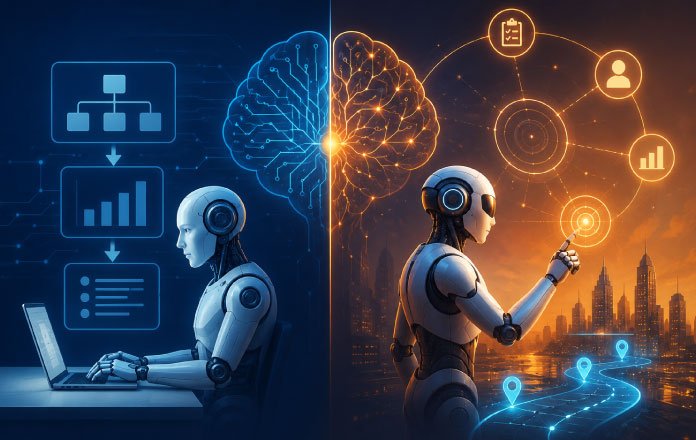
The AI field began with rule-based systems and has since advanced to systems with learning and reasoning capabilities. Current users of AI are primarily exposed to traditional methods, such as chatterbots and predictive systems, that respond to specified inputs. A new model, however, has emerged in the field of AI. The model has been named Agentic AI. Agentic AI will allow the technology to respond to inputs in ways that traditional systems do not. In fact, Agentic AI represents a paradigm shift in how the technology operates.
What is Conventional AI?
Conventional AI systems are systems designed to execute predetermined tasks using pre-programmed rules or patterns derived from historical data. These systems also exhibit reactive behaviour, waiting for human input to process the data and make an appropriate response within a predetermined boundary.
Some examples of conventional AI include spam filters, voice assistants, image recognition algorithms, and even chatbots that answer queries based on data training. Notwithstanding the complexity of even the most sophisticated generative AI models, if such models are limited to the functions they perform based on the inputs they receive, then the definition applies.
Although classical AI is proven to be highly effective at automating tasks, it lacks initiative on its own. It doesn’t decide on its own what it will do next; it just acts according to what it is being asked to do.
Defining Agentic AI
Agentic AI is an AI system capable of autonomous behaviour. Such systems can set goals, plan actions, make decisions, execute tasks, and learn new strategies with very little human intervention. An agent AI system not only reacts but acts. It senses its surroundings, deliberates upon the actions it could take, and takes those steps to accomplish a specific goal or set of goals. More importantly, it can fragment a large goal into smaller ones and modify its actions accordingly.
For instance, optimizing monthly operational costs can be the task of the agentic AI in the business setup. It will not require commands; instead, it will interpret data and provide results, such as optimising the cost structure by recommending measures. It will also be able to take the necessary actions.
Core Features of Agentic AI
Some characteristics of agentic AI are:
Autonomy: It works by itself without needing human input.


Goal Orientation: It is a goal-oriented approach rather than a task-oriented one.
Planning and Reasoning: It can form two-step plans and assess alternatives.
Adaptability: It learns from the outcomes and acts correspondingly.
Continuity: This keeps working towards an objective even after an interaction.
These attributes, when combined, imbue Agentic AI with a sense of agency, making it a much more decision-making entity in the digital realm than a mere tool.
Differences between Agentic AI & Traditional AI
The main fundamental distinction between the two is the role of initiative. Conventional AI systems are reactive, while Agentic AI systems are proactive.
Way of Interaction: Conventional AI requires commands and/or queries to interact. Agentic AI reacts to goals and environmental inputs to take actions.
Scope of Operation: The scope of operation for traditional AI is specific to the task. Agential AI can perform complex tasks across multiple domains.
Human Dependence: Traditional AI is highly dependent on human interaction. Human involvement is removed from Agentic AI. The AI can handle the workflow on its own.
Decision Making: In conventional AI, the decision-making process involves following certain logic or patterns learned. In agent AI, options are considered, and decisions are made based on goals.
Time Horizon: Usually, traditional AI responds in single, isolated interactions. Agencies operate over a period with ongoing progress measurements.
Real-World Applications of Agentic AI
The transformative potential of Agentic AI exists across numerous industries:
Business and Management: Autonomous agents may handle or optimise supply chain management, HR tasks, or project time management.
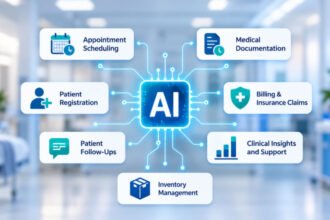
Healthcare: Agent systems can help coordinate patient care, track treatment regimens, and alert to potential problems.
Finance: It would be able to oversee investment portfolios and trade within specified parameters of ethics and regulations.
Education: The learning agents will formulate curricula and monitor students’ progress.
Software Development: The Agentic AI system can code, test, debug, and update applications.
Such applications make it clear that Agentic AI not only assists in decision-making but also makes decisions.
Defining the Problem: The Importance
Despite its potential, Agentic AI poses some fundamental questions. The issue of autonomy is connected to risks regarding responsibility, transparency, and control. The following questions are asked: Who is to be held responsible in the case of an adverse decision made by an autonomous agent? Is it possible to audit the decision processes of an autonomous agent?
Moreover, topics such as self-driving systems, data protection, amplification of bias, displacement, and job displacement, among others, need consideration. With the enhanced capabilities of the Agentic AI system, the development of ethics requires the utmost urgency.
Agentic AI is a significant shift towards AI that began with reactive systems, then proactive ones, and finally towards active and autonomous AI that acts with intention and autonomy. While traditional AI systems have remained highly useful for automating and assisting decision-making, Agentic AI offers the promise of AI that can handle complexity and act alone and independently. In this new frontier that organisations and societies are embarking on, it is essential to appreciate the difference between traditional AI and Agentic AI. Agentic AI, with proper design and strategic use, holds great promise for shaping the future of productivity, innovation, and even human-machine collaboration in the coming years.