




The retail sector is also experiencing one of the most dramatic revolutions in its history. AI, which was previously only used for analytics and automation, is now transforming every nook and corner of the retail industry, from the way goods are stocked and ranged to the way consumers ultimately engage with brands. Though AI retailing holds immense potential for improvement, added operational efficiencies, and cost effectiveness, there is, however, one crucial issue that needs consideration: jobs. With the rise of enhanced automation, there is indeed a danger to employment in the retail industry, which this AI retail revolution will soon threaten.
Rise of AI in the Retail Industry
The adoption of AI technology in the retail industry has snowballed with the development of machine learning, computer vision, robotics, and big data analytics. Retail businesses are using AI technology for forecasting, pricing, inventory management, customer service, and even loss prevention. Self-service checkouts, automated warehouses, cashless retail, and chatbots are already in use, not just in the future. Efficiency is the primary driver of the transformation. AI functions 24×7, minimises errors, reduces operational costs, and processes large datasets much faster than humans. Therefore, jobs that entail repetitive, rule-based, predictable tasks are most likely to be automated.
Cashiers & Checkout Staff
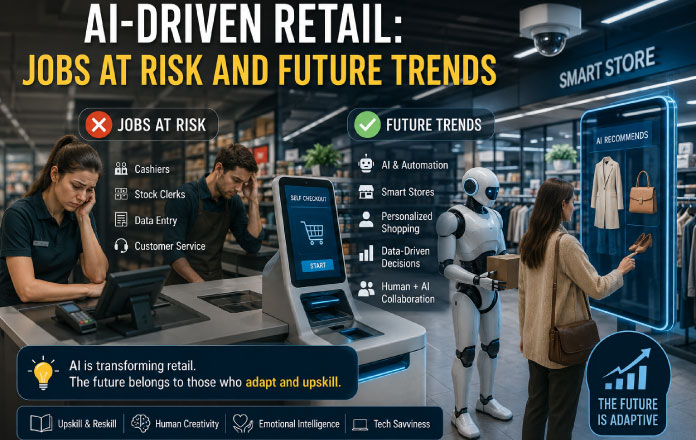
Some of the most prominent occupations that are likely to be endangered include cashiers and checkout operators. This is because self-checkout systems and cashless store layouts that rely on AI-based cameras and sensors lower the requirement for manual labour at billing counters.
AI can recognise items on a shopping list, compute the bill amount, make payments, and detect any possible theft with little or no human assistance. Although cashiers have been a mainstay of retail employment, this trend is increasingly being overtaken or limited as a supporting role for AI systems. Entry-level retail employees are most at risk in this new wave of automation.
Inventory & Stock Management Functions
The danger to inventory clerks and stockroom personnel is also on the rise. This is achieved through the implementation of AI inventory control systems that monitor levels and predict stock replenishment.
Warehouse robotics can sort, transport, and reorganise goods quickly and with higher accuracy than humans. In large retail organisations and e-fulfilment centres, automation technology is already reducing the requirements for manual inventory handling. As the cost of these technologies continues to drop, Automation technology is also expected to penetrate mid-sized retail organisations, diminishing the requirements for conventional inventory jobs.
Customer Service Representatives
Customer service jobs, particularly those involving routine inquiries, are also increasingly being taken over by AI-assisted chatbots and virtual personal assistants. These can assist clients with their queries, track orders, process refunds, and make recommendations 24/7.
Though complex or emotionally charged conversations still require human involvement, a large chunk of customer service activities can be automated. Customer service personnel, such as call centre or help desk assistants operating in stores, are thus moderately to highly exposed.


Sales Associates in Standardised Retail Formats
Salespeople are not necessarily in imminent danger, but those working in standardised, high-volume retail environments are under growing pressure. Recommendation systems, electronic signs, and smartphone applications can assist consumers in making their purchases with the help of AI.
In fashion, technology, and supermarket retail, some machines can suggest goods to buyers based on their preferences and past behaviour. Such machines limit dependency on human customer service. Tasks involving detailed knowledge and experience are less likely to be disrupted.
Visual Merchandisers & Pricing Analysts
AI is also affecting visual merchandising, pricing, and more. It can design store layouts and adjust prices based on demand levels.
Activities undertaken by visual merchandisers and pricing analysts are increasingly data-driven and automated. Although strategic-level direction is still required, the number of experts needed in this field might shrink with more of their tasks being handled by AI systems.
Security & Loss Prevention Personnel
AI-enabled surveillance systems powered by computer vision can identify suspicious activity, spot shoplifting trends, and send alerts without constant human supervision. Face recognition and behavioural analysis algorithms are also being harnessed to curb theft and fraud. Such systems will soon be more accurate. As a result, the physical security monitoring aspect may quickly become redundant. Ethical and legal considerations might hinder this process and slow the sector’s changes.
Jobs Less at Risk in Retail
Not all retailing jobs are equally at risk. Those who demand creativity, emotional intelligence, leadership skills, or high-level decision-making will be more robust. As the roles of store managers, customer experience designers, brand strategists, and HR professionals evolve, they are less likely to be replaced. Similarly, jobs that converge human judgment and technology, such as AI system supervisors, data analysts, and omnichannel experience managers, are likely to grow rather than disappear.
Transformation, Not Total Elimination
The AI retail revolution, rather than the end of retail employment, represents a paradigm shift in work roles. The kind of retail employment most threatened by the AI retail revolution will be that involving routine, repetitive work. For workers, the biggest challenge is reskilling and upskilling, or learning to coexist with AI. The challenge for businesses and the policymaking community is in doing the right thing during this transition. In the years to come, retail will no longer be characterised by ‘human vs. machine,’ but rather ‘human + machine’ collaboration to drive value. Those early adopters will not only survive but help determine the future of the AI revolution.