




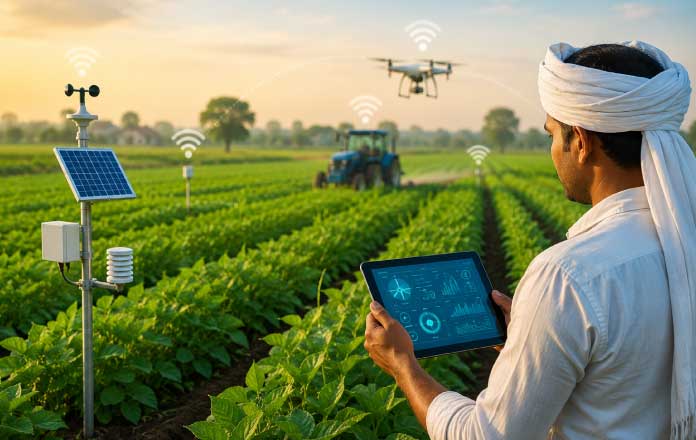
A farmer in Nashik checks his phone before he checks the sky these days. Thirty years working the same land teaches a man plenty, but a sensor buried near his grapevines just told him the soil three feet down has already dried out more than the crop can handle. The sky hasn’t shown that yet. Won’t for another day, maybe two. Small habit, checking the phone first. But it says something about where farming here is actually headed.
IoT gets talked about mostly in the context of smart bulbs and fitness bands. Nobody really brings up the fact that some of its most useful work right now is happening in open fields, not living rooms. This isn’t a pilot tucked away in some lab in Bangalore either. Parts of Maharashtra, Punjab, and Andhra Pradesh are already using it, and in ways that are more practical than flashy.
What Does IoT in Agriculture Even Mean?
Take away the buzzwords and it’s simple enough. Small connected devices sit in soil, on crops, on animals, sometimes bolted onto tractors, and they send data somewhere a farmer can use it. An app. A text message. Occasionally a dashboard some cooperative runs to watch over a dozen farms at once.
The gadget itself isn’t the interesting part. A soil sensor sitting there alone doesn’t achieve much on its own. Connect it to an irrigation system that reacts to what it reads, though, and now the farm has something like a second pair of eyes. One that doesn’t get tired walking the field twice a day and doesn’t miss the small stuff.
Precision Farming Is Doing Most of the Heavy Lifting
This is probably the biggest use case right now, at least the one with the clearest payoff. Sensors keep tabs on moisture, nutrients, temperature, and occasionally the little shifts in microclimate that happen even within one plot of land. No two acres behave the same. Obvious once someone says it out loud. Except Indian farming ran for generations without any real way to do something about that fact.
Drip irrigation tied to a soil moisture sensor is a decent example. Farmers running this setup have reported water savings of close to a third, and better yield alongside it, mostly because the water shows up exactly when the plant needs it instead of on some fixed schedule somebody set years back and never revisited. Agriculture uses close to 80% of the country’s freshwater. So this isn’t a rounding-error improvement. It’s arguably one of the more consequential things happening in water conservation right now, not that it gets talked about that way.
Drones do something similar from above. A quick pass over a field can catch a pest problem or a nutrient gap before it’s visible to anyone standing in the row. That head start is sometimes the whole difference between a bad week and a ruined season.
Watching the Herd, Not Just the Crop
Livestock got the same treatment eventually, just later. A collar sensor on a cow can pick up a fever hours before the animal shows any outward sign of trouble, which sounds minor until you’ve actually run a dairy operation and seen how fast one sick animal turns into five. Some cooperatives in Gujarat started using these collars mainly to track heat cycles for breeding purposes. Catching infections early turned out to be a bonus nobody had really planned for going in.



For most dairy farmers the appeal is fairly unglamorous, honestly. It comes down to money. A sick cow means a vet bill, a few days of lost milk, and in the worse cases, a dead animal. Spotting the fever on day one instead of day three changes that entire calculation. Whether the animal feels more comfortable because of it is a nice thought too, even if that was never really the reason the tech got built in the first place.
What Happens After the Harvest
Here’s a part most agri tech articles skip over completely: the harvest is often the easy bit. Tomatoes rotting in a truck stuck on a highway for six extra hours because nobody knew the refrigeration unit had failed, that’s where a big share of India’s food actually gets lost. Not in the field. On the road, or sitting in a warehouse where the temperature quietly drifted five degrees higher than it should have.
A few logistics companies have started fitting these cold storage trucks with sensors that alert someone the moment temperature or humidity slips out of range, instead of everyone finding out when the shipment arrives spoiled. Nobody’s fixed this fully yet. But even shaving off a chunk of the losses, which run into the thousands of crores annually for perishables, is worth the sensor cost many times over.
There’s also a slower shift happening with buyers themselves. More people ask where their vegetables came from now, whether “organic” printed on a packet actually means something or is just there to justify a higher price. A few supply chains have started pairing IoT tracking with blockchain records so that claim can actually be checked instead of taken on faith. Still fairly rare, but it’s a start.
The Part Nobody Likes Mentioning
It doesn’t roll out this smoothly on the ground, and someone should say that plainly instead of pretending otherwise. Most farmland in India belongs to smallholders, and a farmer working two acres isn’t going to buy a drone outright, the math just doesn’t work for him the way it might for a large commercial farm. Rural internet is patchy in a lot of districts too, and a sensor is basically useless if it can’t get its readings to anyone in time to matter.
There’s a trust issue too, bigger than the cost problem if anything. Farmers don’t adopt something because a startup’s pitch sounded good in a meeting. They adopt it once a neighbour tries it and it obviously, visibly works. Cooperative models and pay-per-use rentals from agri tech startups are chipping away at this slowly, turning ownership into something closer to access.
Where It’s Probably Going Next
More sensors isn’t really the next step. Making sense of the data already piling up is. Predictive tools that flag what’s likely to happen next week rather than just reporting today’s numbers are already being tested in a few states. Add voice assistants in local languages to the mix and suddenly it doesn’t matter whether someone owns a smartphone or knows how an app works.
That’s the real test for this kind of tech, whether it becomes something people just use without thinking about it, rather than something that looks good in a product demo. It won’t replace a farmer’s judgment, and probably shouldn’t try to. What it does is make that judgment harder to get badly wrong.
Nothing here needs every farm wired up before it starts paying off. It’s already happening in bits and pieces, one sensor and one drone flight at a time, even if most people outside the field haven’t noticed yet. Given how much rides on Indian agriculture, water, farmer incomes, food for well over a billion people, that’s probably worth paying attention to.