




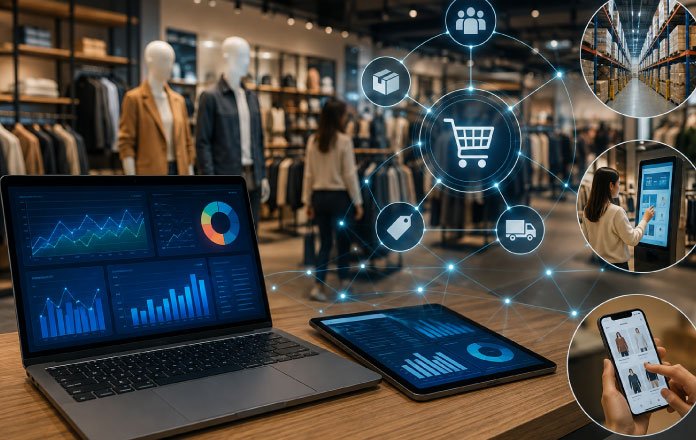
Retail has always depended on understanding customers, managing products, and making the right decisions at the right time. What has changed is the amount of data available to retailers. Every purchase, website visit, product search, customer review, and inventory movement creates information that can be studied.
Data science helps retailers make practical use of this information. It combines statistical analysis, machine learning, predictive analytics and related technologies to understand customer behaviour, forecast demand, improve operations, and support better business decisions.
What Is Data Science in Retail?
Retail refers to the sale of products or services directly to the end customer. These transactions can happen in physical stores, ecommerce websites, mobile applications, or through a combination of channels.
Data science in retail involves collecting and analyzing information from these different sources to solve business problems. The objective is straightforward: understand what is happening, identify patterns, predict what may happen next, and use those findings to make better decisions.
For retailers, this can mean recommending the right product to a customer, maintaining appropriate stock levels, identifying unusual transactions, or understanding why customers are dissatisfied.
Types of Data Used in Retail
Retailers generally work with several major categories of data:
- Customer data: Purchase history, preferences, demographics, browsing activity, and buying behaviour.
- Sales data: Product sales, transaction volumes, store performance, and category performance.
- Operational data: Inventory, logistics, employee activity, equipment performance, and other business processes.
The real value comes from bringing these datasets together. A retailer can then connect customer behaviour with sales and operational information to get a clearer picture of the business.
Key Data Science Use Cases in Retail
1. Customer Segmentation and Personalization
Customers do not all shop in the same way. Data science allows retailers to group customers according to their purchasing patterns, preferences and previous interactions.

Clustering techniques such as K-means and hierarchical clustering can create meaningful customer segments. Predictive models can then help retailers understand likely future behaviour.
This information can be used to show more relevant products, offers, headlines, videos, or other content.
Recommendation engines work similarly. They examine previous purchases, preferences, and browsing activity to suggest products that may interest a particular customer.
Sephora is a useful example. Its Beauty Insider programme uses customer purchase history and shopping behaviour for personalized recommendations, while its Color IQ technology helps customers identify suitable foundation shades.
2. Demand Forecasting and Inventory Management
Keeping too much stock ties up money. Keeping too little can lead to missed sales. Demand forecasting helps retailers find a better balance.
Retailers can analyze previous sales, seasonal changes, promotions, lead times, and other factors to estimate future demand. Time-series methods such as ARIMA and machine learning models can be used for forecasting. Optimization techniques can then support inventory replenishment decisions.
Zara is an example of a retailer using sales information and customer feedback to adjust production and inventory distribution. This helps the company respond quickly when certain products become popular while limiting excess stock.
3. Pricing Optimization
Pricing decisions depend on more than production cost. Demand, customer behaviour, seasonality, competition and price sensitivity can all influence the right price.
Data science models can analyze these factors and help retailers identify suitable pricing points. In some situations, retailers can also adjust prices as demand and market conditions change.
4. Fraud Detection
Retailers process large numbers of transactions, making fraud detection an important area for analytics.
Machine learning models can study historical transactions and identify patterns associated with fraudulent activity. Logistic regression, random forests, and anomaly detection are among the techniques that can be applied. Encryption and tokenization can provide additional protection for sensitive customer information.
PayPal, for example, uses machine learning to assess transaction information, including transaction amount, merchant category, and account activity.
5. Customer Feedback and Sentiment Analysis
Customer feedback is available across reviews, social media, websites, discussion forums, and customer-service channels. Reading all of this information manually is difficult at scale.
Natural language processing (NLP) can analyze large volumes of text and classify sentiment as positive, negative or neutral. Retailers can use these findings to identify recurring complaints, understand customer preferences, and improve products or services.
6. Supply Chain and Store Optimization
Data science is also useful beyond the customer-facing side of retail.
Forecasting and optimization can help retailers plan inventory, improve transportation routes, and manage warehouses. RFID and IoT sensors can provide real-time information about products and equipment.
Inside stores, retailers can analyze customer movement and foot traffic. Heat maps, sensors, RFID systems and video analytics can show which areas receive the most attention and where customers spend their time.
One consumer electronics retailer case reported by DATAFOREST achieved a 9% increase in sales and removed 100% of identified store dead zones after analyzing visitor movement and product visibility.
7. Omnichannel Analytics
Customers often move between websites, mobile apps, physical stores, and customer-service channels before completing a purchase. Retailers therefore need a consistent view of these interactions.
Data warehousing, cloud systems, CRM platforms, data mining, and machine learning can bring information from different channels together. This allows retailers to understand customer journeys more clearly and provide consistent experiences across online and offline channels.
Sephora, for example, connects its online and physical shopping experience through features such as product scanning, inventory checks, reviews, purchases, and virtual product trials.
8. Predictive Maintenance
Retail businesses depend on equipment such as refrigeration systems and other store infrastructure. Unexpected failures can interrupt operations and, in some cases, lead to product losses.
Sensors can collect information about equipment performance, while predictive models can identify unusual patterns and potential failures. Tesco is cited as an example of using data analytics and IoT technologies to monitor refrigeration units and anticipate malfunctions before they cause food spoilage.
Challenges of Data Science in Retail
Data science can deliver strong results, but the foundation has to be reliable.
Data quality is one of the first challenges. Retail information comes from multiple systems and may be incomplete, duplicated, or inaccurate. Data needs to be cleaned and validated before it is used for analysis.
Data security is another concern. Retailers handle sensitive customer information, and a breach can affect both finances and customer trust.
Regulatory compliance also needs attention. Retail companies must ensure that the systems and processes used to collect, store, and process customer information meet applicable legal and security requirements.
What Does a Retail Data Scientist Do?
A retail data scientist combines technical skills with an understanding of business requirements. Depending on the organization, the role may involve analyzing customer and sales data, developing predictive models, defining business metrics, conducting experiments, and communicating findings to stakeholders.
Common technical skills include:
- Python and SQL
- Statistics and probability
- Machine learning
- Data visualisation
- Predictive modelling
- Cloud and data platforms
Business understanding is equally important. A good data scientist needs to understand how retail companies make money, how customers behave, and which metrics actually matter.
How to Build a Career in Retail Data Science
Someone starting in this field should focus on combining technical learning with practical retail problems.
A portfolio project can be a good starting point. Demand forecasting, customer segmentation, recommendation systems, customer retention, fraud detection, or product-search analysis are all relevant examples.
A strong project should not stop at producing a model. It should explain the business problem, the data used, the approach taken, the results, the limitations, and how the solution could be applied in a real business environment.
That combination of technical ability and business thinking is what makes a retail data scientist valuable.
Final Thoughts
Data science has become useful across almost every part of retail. It can help companies understand customers, forecast demand, manage inventory, improve pricing, detect fraud, analyze feedback, optimize supply chains, and maintain equipment.
The technology itself is only one part of the equation. Reliable data, clear business objectives, appropriate security measures, and people who understand both analytics and retail are equally important.
For retailers, the opportunity is to turn large volumes of information into decisions that improve performance. For professionals, retail offers a practical environment where data science can be applied to problems that have a direct business impact.