





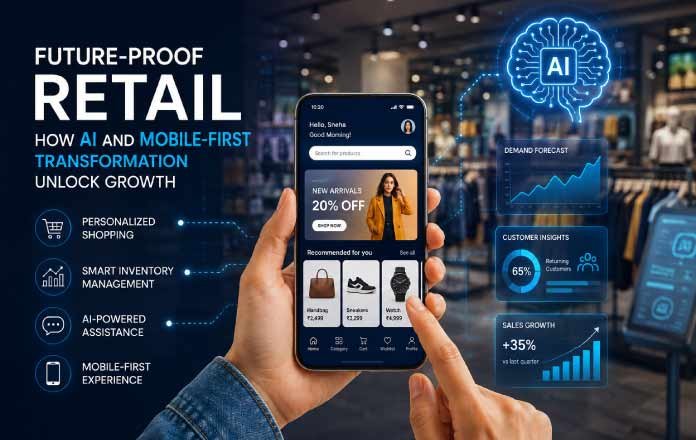
Retail companies are entering a period where technology will play a much bigger role in determining how efficiently they grow. While retailers are looking at revenue growth in the coming years, rising costs, changing customer expectations and outdated technology systems could make that growth harder to achieve.
One of the biggest challenges is not a lack of new technology. It is the presence of old technology that makes it difficult to adopt the new.
Many retailers still operate systems that were designed before mobile wallets, modern APIs and artificial intelligence became part of everyday commerce. Replacing these systems completely can be expensive and disruptive. For many mid-sized retailers, a phased approach makes more practical business sense.
Legacy Technology Can Become a Business Problem
Technology debt is no longer just an IT concern.
Deloitte’s research has shown that a significant share of technology leaders consider technical debt a major barrier to innovation and productivity. Developers also spend a considerable amount of their time maintaining existing systems instead of working on new products and capabilities.
For retailers, the impact can be seen across the business.
Older platforms can make websites and applications slower. They can increase security risks and make it difficult to connect new services. More importantly, they can prevent retailers from introducing features that customers now expect, including faster mobile checkout, personalized recommendations and seamless experiences across online and offline channels.
A marketing team may have a strong idea for a new digital campaign, but if the underlying technology cannot support it, implementation becomes unnecessarily complicated.



The Costs Are Often Hidden
The financial impact of outdated technology is not always visible in a single line item.
Deloitte’s Global Technology Leadership Study found that a large portion of technology budgets continues to be spent on optimizing existing capabilities. That money could otherwise support new digital initiatives and growth opportunities.
Security creates another concern. IBM’s Cost of a Data Breach 2024 reported an average data-breach cost of $4.88 million. Older systems that no longer receive proper updates can increase an organization’s exposure to such risks.
There is also a workforce impact. Developers generally prefer working on meaningful new projects rather than spending most of their time fixing problems created by outdated technology. Persistent technical debt can therefore affect both productivity and employee satisfaction.
For retail businesses, the lesson is straightforward: maintaining old systems indefinitely can eventually cost more than modernizing them.
A Practical Approach to Retail Modernization
Modernization does not have to mean replacing everything at once.
Retailers can take a phased approach that focuses on areas capable of delivering measurable business value.
The first step is to identify and retire technologies that are no longer supported. Continuing to build customer-facing applications on discontinued frameworks can create security, maintenance and compatibility problems.
The next step is to establish a more flexible technology foundation. Cross-platform frameworks such as Flutter can help retailers develop applications for multiple platforms using a shared codebase. Flutter was reported to be used by 42% of mobile developers worldwide, making it an important option for organizations looking to simplify application development.
Mobile should also be central to the strategy.
Salesforce reported that smartphones accounted for 79% of US e-commerce orders during the 2024 holiday season. That figure highlights how strongly mobile has become connected to online shopping behaviour.
Retailers therefore need to consider the complete mobile journey—from product discovery and navigation to payment and order confirmation.
Where AI Can Make a Difference
Artificial intelligence should not be introduced simply because it is popular.
Retailers should begin with areas where AI can solve a clearly defined business problem.
Demand forecasting is one example. Better forecasting can help businesses understand what customers are likely to purchase and plan inventory accordingly.
Inventory management is another area where AI can assist by identifying patterns and helping teams make faster decisions.
Conversational product search can also make online shopping easier by allowing customers to describe what they want in a more natural way.
The important point is to start with practical applications. A small project that delivers measurable savings or productivity improvements can provide a stronger foundation for further investment.
Retailers can also introduce new services through API gateways and micro-frontends. This allows newer capabilities to work alongside existing systems instead of forcing the entire technology environment to be replaced immediately.
What Should Retailers Look for in a Technology Partner?
Choosing the right development partner can have a major impact on the success of modernization.
Retail experience matters. A technology team should understand areas such as inventory, customer journeys, store operations and omnichannel commerce—not just software development.
Look for proven results. Ask potential partners to demonstrate products they have actually delivered and explain the business outcomes those projects achieved.
Check mobile and AI capabilities. Experience should be demonstrated through working products and implementations rather than being listed in a company presentation.
Demand measurable milestones. Deloitte has identified 46 digital-transformation KPIs, while many organizations fail to track a substantial number of them. A good technology partner should establish clear milestones, budgets and performance measures before development begins.
Future-Proof Retail Starts With Better Decisions
Retail modernization is ultimately a business decision supported by technology.
Replacing unsupported systems, improving the technology foundation, designing around mobile shoppers and applying AI where it delivers measurable value can help retailers improve efficiency without taking on the risks of a complete technology overhaul.
The process can begin with focused projects delivered in manageable stages. As each improvement proves its value, retailers can expand the transformation.
There is also a long-term benefit to bringing inventory, customer and sales information together. Better access to this data can give business leaders clearer visibility into margins, demand patterns and changing customer preferences.
The retailers that succeed will not necessarily be those that adopt every new technology first. They will be the ones that understand where technology can solve real business problems—and then implement it with discipline.
For retail leaders, the goal should be simple: modernize where it matters, measure the results and build a technology foundation that can adapt as customer expectations continue to change.