





Technology has made everyday transactions remarkably convenient. We can transfer money through a banking app, renew an insurance policy online, book a hotel room, purchase flight tickets or make a restaurant reservation within minutes.
But convenience has brought its own set of problems.
As more business moves online, criminals have followed suit. Banks, insurance companies, hotels, travel businesses and other service providers handle enormous amounts of customer information every day. Financial details, passwords, identity documents, addresses and payment information can all be valuable in the wrong hands.
For these businesses, cybersecurity is no longer limited to protecting computers from viruses. The bigger concern is protecting customers, transactions, and business operations from attacks that are becoming more organised and harder to detect.
Why Are These Sectors Frequently Targeted?
There is a fairly simple reason. They have information worth stealing.
Banks are an obvious target because criminals can potentially gain direct access to money. Banking systems also contain account details, transaction records, card information and customer identification documents.
Insurance companies maintain equally valuable records. Depending on the type of policy, these can include financial information, property records, claims documents and other personal details.
The leisure industry is sometimes overlooked when discussing cybersecurity. However, hotels, airlines, travel companies, casinos, restaurants and online booking platforms process millions of payments and customer records.



All three industries have also become heavily dependent on mobile apps, websites, cloud services and outside technology vendors. Every new digital connection can create another possible route for an attacker.
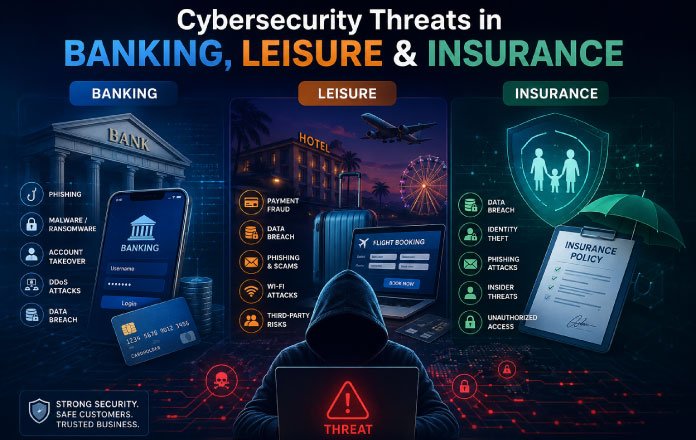
Cybersecurity Threats in Banking
Banking has changed significantly in India and across the world. Customers who once visited a branch for most of their transactions can now manage almost everything on a smartphone.
Cybercriminals understand this change very well.
Phishing and Social Engineering
One of the most common attacks does not begin by hacking the bank. It begins by fooling the customer.
A person may receive an SMS saying that the bank account will be blocked unless KYC details are updated immediately. Another customer may receive a call from someone posing as a bank employee. Fake emails can ask customers to click a link to confirm an unusual transaction.
The purpose is generally the same: create urgency and persuade the victim to disclose information.
Passwords, card details, OTPs, and other credentials obtained in this manner can later be used to commit fraudulent transactions.
The success of phishing shows an important weakness in cybersecurity. Even a bank with strong technical security can fall victim to fraud when a customer or employee is persuaded to hand over sensitive information.
Ransomware
Ransomware is a different kind of problem.
Once ransomware enters an organisation’s network, it can encrypt files and make important systems unavailable. Attackers then demand money to restore access.
The damage may go beyond locked files. Some ransomware groups first copy confidential information and then threaten to release it publicly if their demands are not met.
For a bank, downtime itself is costly. Customers expect access to accounts and payment facilities throughout the day. If important banking systems become unavailable, the impact can quickly spread from IT operations to customer service and the bank’s reputation.
Account Takeover and Stolen Passwords
Password reuse continues to create problems.
Suppose someone’s email address and password are exposed after a breach at an online shopping website. If the person has used the same password elsewhere, criminals may test those credentials on banking and other financial websites.
This practice is commonly known as credential stuffing.
Once an account is compromised, attackers may attempt fraudulent transactions, change account information or collect further personal details.
Banks therefore increasingly depend on additional checks such as multi-factor authentication, transaction monitoring and alerts for unusual login behaviour.
DDoS Attacks
Not every attacker is trying to steal money or information.
Sometimes the intention is to make a service unavailable.
In a Distributed Denial-of-Service, or DDoS, attack, huge volumes of traffic are directed towards an online service. If the system cannot handle the traffic, genuine users may struggle to access it.
For banks, the consequences can be serious. Customers may be unable to use internet banking, mobile applications or payment-related services.
Availability is an important part of banking security because customers expect financial services to work when they need them.
Attacks on Banking Apps, Websites and APIs
A complicated network of applications supports modern banking.
A mobile banking application may communicate with payment platforms, customer databases, fintech services and several internal systems. APIs are commonly used to enable these connections.
Attackers continuously look for weaknesses in these applications.
An outdated component, a weak authentication process, a coding error, or a poorly protected API can provide an opportunity to access a system or information.
Regular security testing has therefore become essential, particularly when banks introduce new digital services.
Cybersecurity Threats in the Leisure Industry
Cybersecurity is equally important for hotels, airlines, travel companies, restaurants, entertainment businesses and booking platforms.
These businesses process a large number of transactions, particularly during holiday and travel seasons.
Payment and Card Information Theft
A hotel or travel website may process thousands of card payments every day.
Attackers may target booking websites, payment gateways, point-of-sale machines or customer accounts to obtain payment information.
Managing this risk becomes more complicated for large hotel and travel businesses because they often work with several payment processors, booking partners and technology vendors.
One weak system can create problems elsewhere.
Customer Information Breaches
Travel and hospitality businesses can hold surprisingly detailed customer records.
A hotel booking may include a customer’s full name, mobile number, email address, payment information and travel dates. International travel bookings may involve passport details and other identification information.
Loyalty programmes create another valuable source of customer data.
If criminals obtain this information, they can use it for identity fraud or create convincing scams based on genuine travel details.
For example, a fraudulent message about a hotel reservation becomes much more believable when the criminal already knows where and when the customer is travelling.
Fake Booking Messages
Travellers are used to receiving confirmation emails, payment reminders and updates from hotels and airlines. Criminals take advantage of this behaviour.
A fake email may ask a customer to reconfirm a hotel reservation by making a small payment. Another message may claim that a flight booking requires immediate verification.
The link can lead to a website that looks almost identical to the genuine booking platform.
Holiday periods can be particularly attractive to fraudsters because customers are making more bookings and may respond quickly to messages that appear to concern an upcoming trip.
Ransomware and Business Disruption
For a hotel, a cyberattack is not necessarily an invisible problem confined to a server room.
Imagine a hotel where the reservation system stops working during check-in time. Staff cannot confirm bookings, payment terminals are unavailable and internal systems cannot be accessed.
The effect reaches customers almost immediately.
This is why leisure businesses need to think about cybersecurity as part of their day-to-day operations, not simply as an IT requirement.
Cybersecurity Threats in Insurance
Insurance companies have a slightly different problem. Their databases can contain customer information collected over many years.
Depending on the insurance product, records may include identity documents, financial information, addresses, property details, policy information and claims records.
That makes insurers attractive targets.
Theft of Customer Data
A stolen password can be changed. Personal information is more difficult to replace.
Once identity documents or other confidential customer records are exposed, the information may remain useful to criminals for a long period.
Stolen data can be used for identity theft, fraudulent applications, account takeover and targeted phishing.
Insurance companies therefore have to protect information not only when customers submit it but also throughout the period the company retains it.
Digital Insurance Fraud
Fraud has always been a challenge for insurers, but online systems have introduced new methods.
Criminals may use stolen identities to create policies, access genuine customer accounts or submit fraudulent claims.
This creates an overlap between fraud prevention and cybersecurity.
Security teams may detect an unusual login while a fraud team identifies suspicious claim activity. Connecting these signals can help an insurer spot a problem earlier.
Third-Party Risks
Insurance companies rarely work in isolation.
They deal with brokers, hospitals, garages, surveyors, claims processors, cloud providers, software companies and other outside organisations.
Every partner that has access to company systems or customer information needs appropriate security controls.
Cybercriminals know that attacking a smaller vendor may sometimes be easier than directly attacking a major insurer.
A company’s security, therefore, depends partly on how carefully it selects, monitors, and manages its technology partners.
Employees and Customers Are Part of Cybersecurity
Technology can block many attacks, but human judgement remains important.
An employee can accidentally open an infected attachment. A customer may enter a password on a fake banking website. A finance executive could receive a convincing message requesting an urgent payment.
Cybersecurity awareness should therefore be practical.
Employees need to know how to identify suspicious links, unexpected attachments, unusual payment instructions and requests for confidential information. Customers should also be regularly reminded that banks and other financial organisations will not ask them to share passwords, PINs or OTPs through unsolicited calls or messages.
Training once a year is not enough. Fraud methods evolve quickly, and awareness programmes need to keep pace.
What Can Companies Do to Reduce the Risk?
There is no single security product that can solve the entire problem.
Good cybersecurity usually comes from consistently and correctly doing several basic things.
Multi-factor authentication should be used for sensitive systems. Software needs to be patched on time. Important information should be encrypted, and businesses should maintain secure backups that can be restored if systems are attacked.
Access also needs to be controlled carefully. An employee should not have access to every system simply because they work for the company.
Websites, mobile applications and APIs require regular security assessments, particularly after major updates.
Businesses also need an incident response plan in place before an incident occurs.
Who will investigate the attack? Which systems should be isolated? How will services be restored? Who will communicate with customers? What information needs to be reported to regulators?
These questions are much easier to answer during a planned exercise than in the middle of an actual cyberattack.
Third-party vendors deserve the same attention. Companies should know what customer information vendors can access, how that information is protected and what happens if the vendor suffers a security incident.
Cybersecurity Has Become a Business Responsibility
A few years ago, cybersecurity discussions were largely left to IT departments. That approach no longer works.
A major breach can affect sales, customer confidence, regulatory compliance, and a company’s reputation. Senior management, therefore, has a direct interest in how cyber risks are managed.
The challenge will become more complicated as banks, insurers and leisure businesses adopt more cloud services, APIs, mobile applications and automated systems.
Attackers are also changing their methods. They are becoming better at creating believable messages, identifying technical weaknesses and taking advantage of trusted suppliers.
Companies cannot assume that every cyberattack can be prevented. What they can do is make attacks harder, identify suspicious activity sooner and ensure that the business can recover quickly when an incident occurs.
Conclusion
Banking, leisure and insurance may appear to be very different industries. Still, from a cybersecurity perspective, they have something important in common: all three handle information that criminals can monetise.
Banks need to protect accounts, transactions and digital banking infrastructure. Hotels and travel businesses need to secure booking systems, customer records and payments. Insurance companies have the additional responsibility of protecting detailed customer information accumulated over long periods.
Phishing, ransomware, account takeover, DDoS attacks, data theft, application vulnerabilities and third-party breaches will continue to create problems for these industries.
The answer is not to rely on a single security tool or to wait until something goes wrong.
Businesses need sensible access controls, secure applications, trained employees, reliable backups, regular testing and a clear plan for responding to incidents. More importantly, cybersecurity has to be treated as an everyday business responsibility.
Customers are willing to use digital services because they trust companies with their money and personal information. Protecting that trust is ultimately what cybersecurity is about.